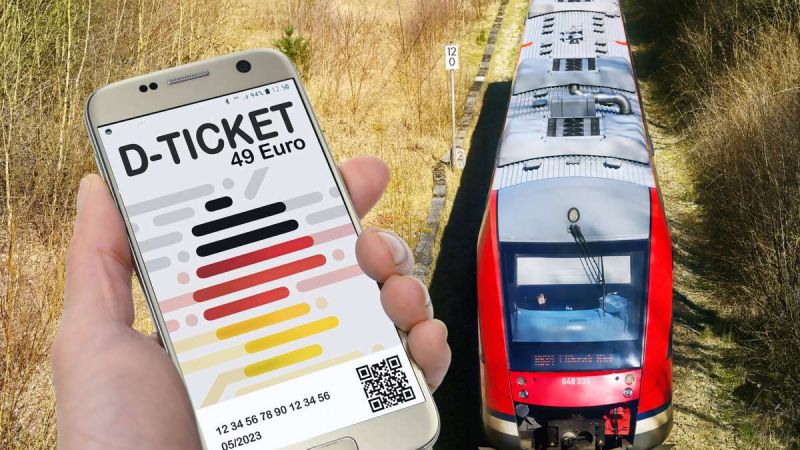
Germany introduced on Monday a brand-new, all-encompassing flat-rate ticket for public transportation. However, the pass’s €49 (US$54) price has cast doubt on its potential impact.
Promoting the monthly pass as a “revolution”, policymakers hope it will bring some help for customers in the midst of taking off expansion, and urge individuals to lean toward mass travel for the sake of the climate.
The “Deutschlandticket” offers unlimited access to Germany’s bus, metro, and local and regional train systems, with the exception of long-distance high-speed services.
Transport Minister Volker Wissing rushed to refer to the new initiative as “the biggest public transport reform in German history”, however, the pass’ success is not even close to guaranteed.
The offer is expected to be accepted by 16 million of Germany’s 84 million residents, according to the VDV Association of transport companies. Including those who will upgrade from their current transportation subscription, approximately 750,000 tickets have already been sold.
How to finance the new policy was the subject of months of debate, postponing the roll-out of the ticket
In order to avoid adding to the debt load of the national rail operator, a deal was reached between the federal government and the states of Germany. Each state will contribute €1.5 billion to the financing of the ticket.
The opposition has voiced strong disapproval of the expenditure, arguing that it could have been used to “improve and renovate rail infrastructure,” as conservative (CDU) parliamentarian Michael Donth put it.
According to official estimates, Germany’s rail network is in fact creaking, necessitating annual investments of approximately €8.6 billion over the next ten years.
In 2022, only 65.2% of long-distance trains arrived on time, with services jammed and frequent technical issues.
When the government tried out a heavily discounted flat-rate ticket for the first time in the summer, the problems with Germany’s rail system came to the forefront. Locals were able to travel the entire country for just €9 per month between June and August.
With 52 million people signing up for the offer, there was clearly a lot of interest in the pass. However, operators had trouble controlling the stampede.
“The solution is certainly not reducing the cost of subscriptions,” Christian Boettger, a rail expert from the Technical University Berlin, said.
To ensure that the new ticket model continues to be financially viable, Transport Minister Wissing has not ruled out the possibility of raising its price in the future.
Similarly, getting people to use public transportation instead of their cars is frequently easier said than done.
According to Boettger, many commuters who live far from the city center lack “rail infrastructure that could replace the car.”
Road traffic “stagnated” rather than rising following the introduction of the nine-euro offer, according to the federal statistics agency Destatis.
The federal environment agency estimates that road vehicles contributed 0.8 million additional tonnes of greenhouse gases in 2022, up from the previous year.
The new ticket, which can only be purchased through a subscription, is significantly less expensive than typical monthly rates, making it one of the most affordable public transportation deals anywhere in the world.
According to transportation expert Oliver Wittig, the €49 ticket will be especially beneficial to “urban residents who already have a more expensive subscription.”
Germany is not the only nation working to increase rail use to cut down on transportation-related emissions.
In an effort to encourage residents of Spain to abandon their automobiles and alleviate inflationary pressures, free passes for both local and regional trains were introduced in September.
In the first quarter of 2023, 2.1 million tickets were distributed, as stated by the Spanish operator Renfe.
In Austria, a “climate ticket” allows clients the opportunity to use virtually all the alpine country’s public transport network, including high-speed trains, for simply over €1,000 per year. According to the Austrian operator OBB, a “boom” in rail traffic has resulted from the ticket’s popularity.
However, not everyone embraces the concept. “It costs too much and there is very little switching from car to train travel,” France’s Transport Minister Clement Beaune told the National Assembly.
While the release of iOS 27 took much of the attention, Apple also rolled out… Read More
Adjusting your AirPods settings can make a noticeable difference to your listening experience by providing… Read More
How separate investment and philanthropic mandates can support research project readiness and durable conservation outcomes… Read More
The September 2026 full moon will reach its peak at 12:49 p.m. EDT (1649 GMT)… Read More
LAGOS, Nigeria — Cambodian digital creator and entrepreneur Song Ethong, together with creative collaborator Ros… Read More
Most founders spend their first year obsessing over product-market fit, not paperwork. That focus makes… Read More
