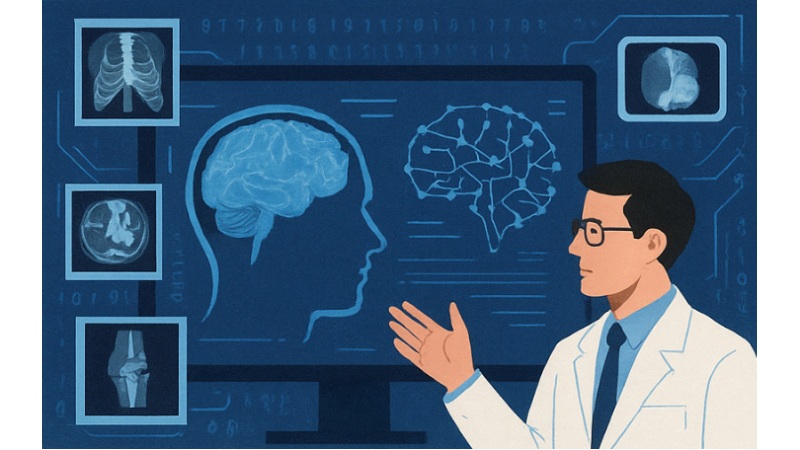
In a significant leap for modern healthcare, artificial intelligence (AI) and machine learning (ML) are revolutionizing the field of medical imaging, enhancing diagnostic accuracy, speeding up analysis, and improving patient outcomes across the globe.
Medical imaging technologies like X-rays, CT scans, MRIs, and ultrasounds have long been critical tools for diagnosing a range of conditions. However, interpreting these images can be time-consuming and prone to human error. AI and ML are now stepping in to augment radiologists’ capabilities, offering tools that can rapidly and accurately detect anomalies, such as tumors, fractures, and lesions. Recent studies have shown that AI algorithms can match or even surpass human radiologists in diagnosing certain conditions. For instance, Google Health’s AI model demonstrated a higher accuracy rate than expert radiologists in detecting breast cancer from mammograms. Similarly, researchers from MIT and Harvard have developed ML systems capable of identifying early signs of Alzheimer’s disease from brain scans with remarkable precision.
How It Works-Machine learning models are trained on vast datasets of medical images. These systems learn to recognize patterns and anomalies by comparing thousands — sometimes millions — of examples. With each new image, the model becomes smarter, constantly refining its accuracy.
Deep learning, a subset of ML that mimics the neural networks of the human brain, is particularly effective in image recognition. These networks can highlight subtle variations that may be missed by the human eye, such as early-stage tumors or microscopic tissue changes.
Real-World Impact-Hospitals and healthcare providers are already reaping the benefits. AI-driven imaging tools are reducing diagnosis time from hours to minutes, allowing for faster treatment decisions. In rural and underserved areas, where access to specialists is limited, AI-powered portable devices are proving to be game changers.
In India, for example, AI tools are being used to screen for tuberculosis and diabetic retinopathy using mobile X-ray vans and smartphone-based fundus cameras. In the United States, several hospitals have integrated AI systems to prioritize emergency cases by flagging critical findings, such as brain hemorrhages, in real time.
As AI and ML continue to evolve, their integration into medical imaging holds the potential to make healthcare more efficient, accurate, and accessible—ultimately saving lives and shaping the future of medicine.
Dr Jasneet Chawla
Associate Professor
Chandigarh University
Renovating a building that people still use is a balancing act. Owners want to improve… Read More
Live dispatch keeps a fire watch running at every hour by giving each guard a… Read More
Once your parents turn 60, renewing the family's medical cover raises a real question. Do… Read More
By Credible Law, a legal information and attorney referral resource for business owners navigating merchant… Read More
For years, owning a home in prime central London was treated as almost self-evidently sensible.… Read More
An electric bike may cost less to run than a petrol model, but repairs can… Read More
