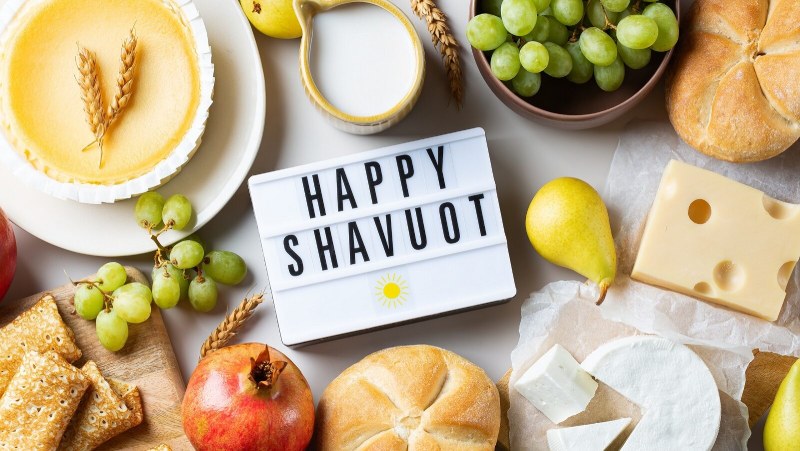
Shavuot is a significant Jewish festival that marks the conclusion of the Omer count and celebrates the giving of the Torah at Mount Sinai, a fundamental event in Jewish tradition.
The most significant event in Jewish history—the receiving of the Torah on Mount Sinai—is celebrated on Shavuot, which may not receive as much attention as other Jewish holidays like Hanukkah, Passover, and Purim.
From an agricultural perspective, Shavuot signifies the start of the wheat harvest and the day when the season’s first produce was offered at the Temple. From a historical perspective, it marks the anniversary of the Jewish people’s covenant with God and the giving of the Torah on Mount Sinai.
Traditionally, people celebrate the day by reading the Book of Ruth, eating dairy products, going to synagogue, studying Torah all night (or late into the night), and skipping work.
Tens of thousands of Jews in Jerusalem who have spent the entire night studying the Torah make their way to the Kotel (Western Wall) at the break of dawn to perform the Shacharit ritual.
Shavuot has numerous important lessons, some of which are listed here. We reaffirm our dedication to God and the Torah, learn the Torah, celebrate our Jewish identity, and renew our connection to one another.
Shavuot commences on the sixth day of the Hebrew month of Sivan, immediately following the conclusion of the 49-day Omer counting period. It is observed on a single day in Israel and for two days outside of Israel.
In the Diaspora, Shavuot starts on the evening of Sunday, June 1, 2025, and lasts until the evening of Tuesday, June 3, 2025.
This year, the holiday starts on Sunday, June 1st (6 Sivan 5785) in the evening and concludes at dusk on Tuesday, June 3rd (8 Sivan 5785). It lasts until midnight on June 2 and is observed for two days in the Diaspora and just one day in Israel.
The seven weeks of counting from Passover to Shavuot, sometimes referred to as the “Counting of the Omer,” are completed on Shavuot, which means “weeks” in Hebrew.
It is one of the three main Jewish pilgrimage festivals, and its name comes from several fundamental origins, each of which captures a distinct aspect of the holiday’s nature and background:
Shavuot, also known as the “Feast of the Harvest,” commemorates the wheat harvest, which represents the success of agriculture.
It honors the Temple-era tradition of presenting the year’s first produce as a token of gratitude and is known as the “Feast of First Fruits.”
The event has great religious and spiritual significance since, according to Jewish tradition, the Torah was given on this day at Mount Sinai.
Like many Jewish holidays, Shavuot is celebrated with a festive meal, special prayers, and a day off from work. Additionally, there are several traditions connected to the day:
Dairy products are traditionally consumed on the first day of Shavuot. Shir HaShirim (Song of Songs) 4:11’s statement that “honey and milk shall be under your tongue,” which is interpreted to refer to the Torah, provides one reason for this custom. Alternatively, it represents the “land flowing with milk and honey” that the Israelites were promised (Shemot/Exodus 3:8). (This does not, however, explain why humans do not eat honey.)
Another explanation is that the Jewish people rejoiced by eating dairy products after learning that the meat they were eating was not Kosher after receiving the Torah (Mishnah Berurah 494:12).
Another Kabbalistic (Jewish mystical) theory is that the Hebrew word for milk, chalav, has a gematria (numerical value) of 40, which represents the number of days that Moses spent receiving the Torah on Mount Sinai (Rabbi Yitzhak Lipietz, Sefer Matamim).
“Happy Shavuot,” or one of the following can be used to greet someone on Shavuot:
A Complete Summer Skincare Guide by Blossom Kochhar Aroma Magic Summer is not just a… Read More
The United Arab Emirates has emerged as a global hotspot for luxury travel, attracting visitors… Read More
Google is introducing the standalone Gemini Enterprise app for Android, which will deliver its corporate-grade… Read More
Digital payments have changed how we handle money. Whether you are paying for a small… Read More
Taking care of your health and well-being doesn’t have to mean dramatic changes or strict… Read More
We often talk about growing up as if emotions mature on a perfect timeline, children… Read More
