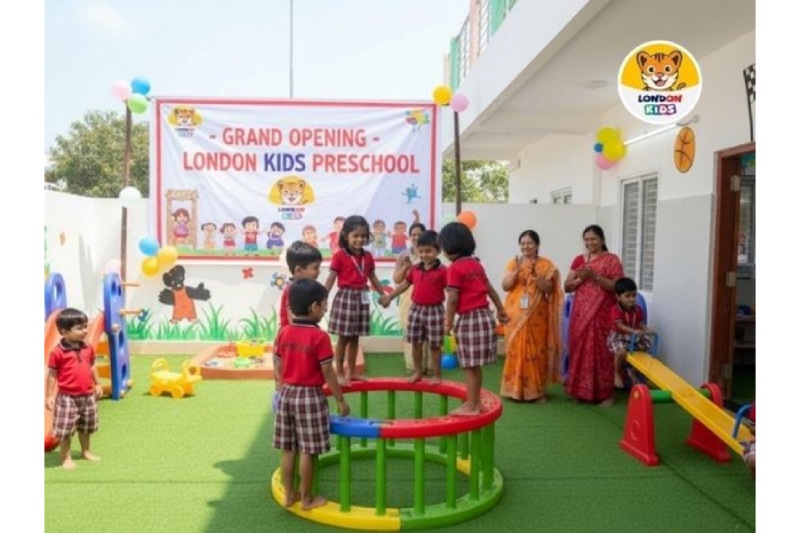
Rising awareness among parents and policy support under NEP 2020 are driving demand for organized preschool learning in emerging Indian cities.
Early childhood education in India is steadily evolving from an informal, play-based routine into a more structured and intentional phase of learning. This transition, once largely confined to metropolitan cities, is now becoming visible in smaller but rapidly developing urban centers such as Tirupati. The recent opening of a new preschool center by London Kids Preschool, under the ownership of K. Venkatesh, reflects this broader shift in how early learning is perceived and adopted by families.
Early childhood education refers to the structured development of children between the ages of 2 and 6, focusing on foundational skills such as communication, motor abilities, emotional intelligence, and social interaction. For years, this stage in India remained loosely organized, with varying standards across institutions. However, increased awareness about brain development in early years has encouraged parents to seek more structured and research-backed learning environments for their children.
This shift has gained further momentum with the introduction of the National Education Policy (NEP) 2020, which places strong emphasis on foundational literacy and numeracy. The policy recognizes that nearly 85% of a child’s brain development occurs before the age of six, making early education a critical component of the overall learning journey. As a result, preschools are no longer viewed merely as childcare spaces but as essential institutions that shape a child’s cognitive and social foundation.
Tirupati, traditionally known for its cultural significance, is now witnessing a gradual transformation in its educational outlook. With a growing middle-class population and increased access to digital information, parents in the city are becoming more informed and selective about early education choices. This awareness is influencing demand for preschools that offer structured curricula, trained educators, and a balanced approach to learning.
Educational observers note that parents today are asking more specific questions: What teaching methods are used? How is progress measured? Is the learning environment engaging yet disciplined? These questions indicate a clear shift from convenience-based decisions to quality-driven choices. In such a context, the presence of organized preschool centers becomes relevant not only for accessibility but also for setting benchmarks in early learning practices.
The newly opened center in Tirupati represents a response to this changing demand. While it is one among several institutions entering emerging cities, it highlights a growing trend—structured preschool education is no longer limited to large urban hubs. Instead, it is gradually becoming accessible to families in cities that are expanding both economically and socially.
“Structured early education is no longer a luxury in India’s smaller cities; it is becoming an essential step in preparing children for formal schooling and lifelong learning.”
— Vikas Singh, Co-founder, London Kids Preschool
A structured preschool curriculum typically integrates multiple aspects of development through planned activities. These include language development, early numeracy, creative expression, and social interaction. Unlike unstructured setups, such environments provide consistency, allowing children to develop routines while also exploring their curiosity. This balance between guided learning and play is increasingly being recognized as effective in nurturing confident and adaptable learners.
Another important aspect influencing this transition is the changing family structure. With more nuclear families and working parents, preschools are also expected to support emotional and social development. Children benefit from peer interaction, collaborative activities, and exposure to diverse learning experiences elements that are not always available in home settings.
At the same time, the expansion of organized preschool networks into cities like Tirupati reflects a cautious and measured growth approach within the industry. Rather than rapid scaling, many institutions are focusing on adapting to local needs, ensuring that curriculum delivery and infrastructure align with community expectations. This localized approach is essential in maintaining relevance and building trust among parents.
The broader preschool sector in India is expected to grow steadily in the coming years, driven by urbanization, rising incomes, and increased educational awareness. However, growth is also likely to bring greater scrutiny. Parents are becoming more discerning, and there is a growing expectation for transparency in curriculum, teacher qualifications, and child safety standards.
In this evolving landscape, the presence of centers such as the one established by K. Venkatesh offers a glimpse into how early education is being reshaped at the grassroots level. It is not merely about introducing a new institution but about contributing to a wider cultural shift that values structured early learning as a foundation for future success.
The expansion of organized preschool education into Tirupati underscores a larger narrative unfolding across India. Early education is gradually being recognized as a critical investment rather than an optional phase. As awareness continues to grow, more families are likely to seek environments that combine structure, creativity, and care ensuring that children begin their educational journey on a strong and thoughtful foundation.
Zagreb, March 2026 – Credavi, a Croatian online loan provider, today celebrated its first anniversary by… Read More
Pune, India – In a digital landscape where AI-first press release distribution is redefining how… Read More
Rising housing costs have become a defining challenge for many American families, reshaping where and… Read More
Image source: Unsplash Child abuse and neglect remain pressing concerns within healthcare, requiring a vigilant… Read More
In today’s technology-driven world, innovation is often measured by speed, scale, and disruption. New platforms… Read More
Throughout his career, Paul Favret has consistently exhibited a rare blend of vision, adaptability, and… Read More
