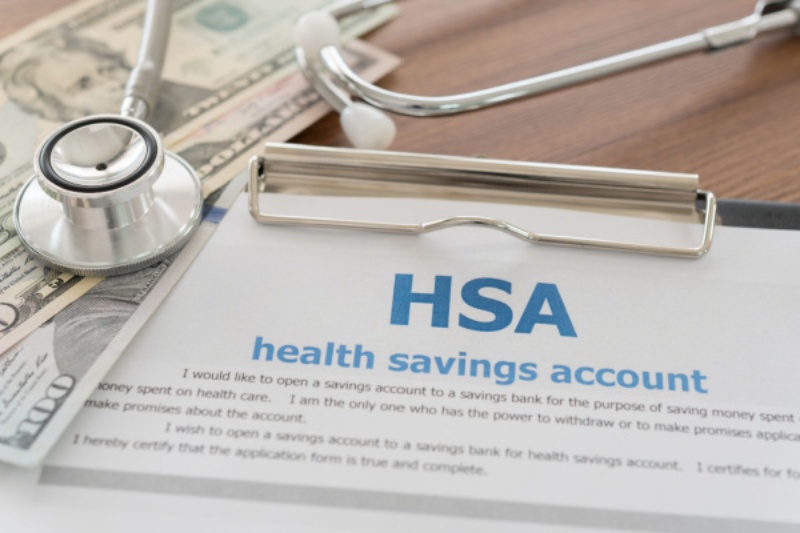
People with high-deductible health plans can use health savings accounts (HSAs) to help cover eligible medical costs before their deductible is satisfied.
You have to be enrolled in a high-deductible health plan (HDHP) offered by your employer or one you’ve bought yourself to be qualified to open an HSA account.
While some financial institutions also provide employer-sponsored HSAs that enable account holders to benefit from automatic payroll deductions, other financial institutions only accept cash contributions for their HSAs. Your funds, whether provided by your employer or a financial institution, are withheld tax-free until such time as they are required to cover eligible medical costs.
Your employer is likely contributing to your HSA if you have one through them. HSA accounts are frequently funded without an employer matching requirement, in contrast to a standard 401(k), where employers match employee contributions up to a certain amount.
The account holder is not the only one who can contribute to an HSA savings account. Anyone, including friends and family, can make contributions to qualified HSA accounts, provided the account owner satisfies all eligibility requirements.
There are penalties for using an HSA account for any other purpose than helping to defray the costs of HDHP. If, as an under-65, you take money out of your HSA for anything other than eligible medical expenses, you will be subject to an additional 20% tax penalty on top of your income tax.
The IRS maintains a comprehensive list of approved medical costs that are eligible to be reimbursed with HSA funds. Prescription medications, dental, vision, and co-pays are typically among them.
An excellent feature of an HSA is that any money left in the account at the end of the year is carried over and grows even more. An HSA does not have this requirement, in contrast to an FSA, which mandates that you use all of the funds or risk forfeiting them by the end of the year (with some restrictions). Thus, you don’t have to use an HSA to spend December scheduling appointments and trying to spend the entire amount in the account if you don’t need to access it for medical expenses during the year.
If your employer does not offer the option, you will need to choose how much you want to contribute each year once you have opened an HSA through a financial institution or your employer. The maximum amount you can deposit into an HSA in 2024 is $4,150 for single people and $8,300 for families.
Flexible spending accounts (FSAs) and Health Savings Accounts (HSAs) differ primarily in that the former requires employment as the plans are sponsored by employers, and the latter requires the use of all funds within the account by the end of the year.
While withdrawals from an FSA are not allowed for reasons other than qualifying medical expenses, both types of accounts may be used for medical expenses. Furthermore, fixed contributions to an HSA may result in tax penalties if altered or withdrawn for reasons other than medical costs.
HSAs are a terrific way to save for unforeseen medical costs while watching your money grow tax-deferred, but they’re not for everyone. Still, owning an HDHP might not be the best option if you have health issues that necessitate expensive prescription drugs and frequent doctor visits, or if you are almost retirement age and will soon be on Medicare. It might be wiser to look for different ways to invest and save your money.
iOS 27 launched this week as a major update for the iPhone, and here are… Read More
With iOS 27 now available, CarPlay receives its most significant refresh in years. However, which… Read More
Google left out one detail from its announcement about the new Search profiles features revealed… Read More
Samsung Electronics Co., Ltd. has announced that One UI 9 is expanding to additional Galaxy… Read More
September is offering skywatchers several opportunities to observe notable events. Venus will reach its greatest… Read More
SIU Swiss International University, a member of the VBNN Smart Education Group, has officially opened… Read More
