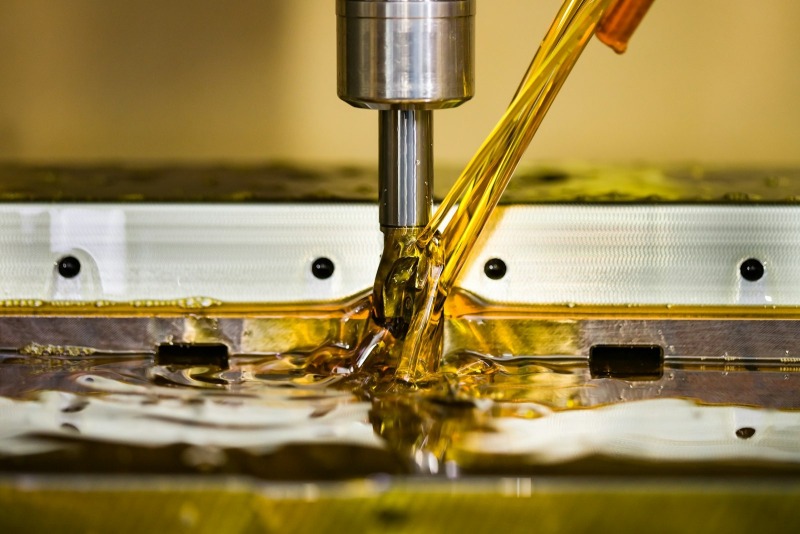
When a machine shop starts falling behind its production targets, the cause isn’t always a major equipment failure. Smaller problems can add up just as quickly. A cutting tool wears out earlier than expected. A machine sits idle while the tool is changed. A part has to be scrapped because the cutting edge started to deteriorate halfway through the run.
The metalworking fluid running over that tool plays a bigger role in those outcomes than it may seem. Concentration, lubrication, cooling, and the fluid’s condition can all affect how quickly a tool wears and how consistently a machine produces usable parts. That’s why Austin Morelock pays close attention to the relationship between coolant chemistry and machine-shop performance, including the production costs that can follow when the chemistry isn’t properly controlled.
The reason becomes clearer when you look at what happens where the tool meets the workpiece. A carbide insert cutting steel at high speed is operating under considerable heat and pressure. The cutting edge must withstand that environment repeatedly, often across thousands of parts.
Metalworking fluids help manage what is happening at the point of contact. The right formulation can reduce friction, carry heat away from the cutting zone, and help protect the cutting edge as it moves through the material. If the fluid isn’t performing as expected, tool wear can accelerate, and the effects begin to show up elsewhere in the operation through more frequent changeovers, inconsistent parts, and additional downtime.
For Morelock, that’s why coolant shouldn’t be treated as a background consumable that only gets attention when something goes noticeably wrong. Tool selection, feeds and speeds, and metalworking chemistry all affect what happens during the cut. Looking closely at the fluid is another part of understanding why a tool lasts as long as it does—and why, in some shops, it doesn’t.
Cutting tools don’t wear out in only one way, which is part of what makes choosing the right metalworking fluid more complicated. Different types of wear have different causes, and the chemistry that helps with one problem may not help another.
Abrasive wear is probably the easiest to picture. Hard particles in the workpiece gradually wear away at the cutting edge, turning what started as a sharp edge into a more rounded one. Adhesive wear happens differently. Under enough heat and pressure, material from the workpiece can begin sticking to the tool. As that material breaks away, it can take small pieces of the cutting edge with it. This is also how built-up edge develops, affecting surface finish and eventually contributing to tool failure.
At higher temperatures, diffusion wear can become a problem as elements move between the cutting tool and the machined material. Thermal cracking comes from repeated heating and cooling of the cutting edge, something that can be especially important in interrupted cuts and milling operations where the tool repeatedly enters and leaves the material.
Heat, friction, and direct surface contact play a role in several of these processes. A properly selected metalworking fluid can help control those conditions, reducing stress on the cutting edge and slowing the wear that eventually takes a tool out of service.
That doesn’t mean chemistry can prevent every type of tool failure. Tool material, cutting parameters, workpiece material, machine condition, and the operation itself still matter. The fluid is one part of that system, but it’s also easy to overlook.
Metalworking fluids are generally asked to do two important jobs at once: carry heat away from the cutting zone and reduce friction where surfaces move against one another.
Those jobs don’t always call for the same formulation.
Water is very effective at carrying away heat, while oil provides stronger lubrication. Straight oils sit toward the lubrication end of that spectrum and can work well in slower, demanding operations such as broaching, tapping, and thread rolling. Soluble oils, semi-synthetics, and full synthetics contain more water and offer different balances between lubrication and cooling.
The right balance depends on the operation. High-speed machining can generate substantial heat at the cutting edge, making cooling especially important. Other processes emphasize reducing friction and preventing the tool and workpiece from making damaging contact.
Additives give formulators another way to manage those conditions. Extreme-pressure additives are designed to react under the heat and pressure created during cutting, forming a protective film at the tool-workpiece interface. Boundary lubricants can provide similar protection under less extreme conditions.
This is also where the material being machined matters. A formulation that performs extremely well with one metal isn’t automatically appropriate for another. Certain additive packages can interact poorly with particular alloys, affecting appearance, corrosion, or the finished surface.
Austin Morelock emphasizes this material-specific approach in his work in industrial chemistry. Choosing a fluid isn’t simply a matter of finding the product with the strongest performance claims. It has to make sense for the material, process, equipment, and operating conditions where it will actually be used.
Tool life is relatively easy to measure. A shop can track how many parts a tool produces before it needs to be replaced and compare that number from one run to another.
Some of the costs associated with metalworking fluids are less obvious.
A sump that develops bacterial contamination over a long shutdown may need to be drained, cleaned, and recharged before production can return to normal. That means fluid and disposal costs, but it also means lost production time.
Poor filtration creates a different problem. If fine metal particles continue circulating through the system, they can contribute to wear and interfere with the surface finish the shop is trying to produce. Excessive foam can keep fluid from reaching the cutting zone effectively and create additional cleanup and safety concerns around the machine.
Operator comfort belongs in the calculation, too. Skin irritation or other problems associated with poorly maintained fluid can become a workplace issue long before anyone connects them to the cost of running the machine.
These are some of the reasons Morelock argues that fluid selection can’t be based on purchase price alone. A less expensive product isn’t necessarily saving money if it requires more frequent sump changes, creates filtration problems, contributes to shorter tool life, or makes the working environment harder on operators.
Those costs rarely appear on a single budget line. They show up in maintenance, tooling, scrap, labor, and missed production time, making the connection easy to miss.
It’s tempting to assume that poor coolant performance means the shop needs a different fluid. Sometimes it does. In many cases, though, the first place to look is how the existing fluid is being maintained.
Concentration is one of the basics. If a water-miscible fluid becomes too dilute, it may not provide the intended level of lubrication or corrosion protection, and microbial control can suffer. If the concentration becomes too high, other problems can develop, including residue, foaming, and a higher risk of skin irritation.
A refractometer gives operators a simple way to monitor concentration and catch changes before they become bigger problems.
Water quality matters, too. Minerals in hard water can interact with components in a metalworking fluid and leave deposits behind, while very soft water can make some formulations more prone to foaming. The right water treatment depends on the fluid and the shop conditions, but the key point is that the water in the mixture is part of the chemistry, too.
From there, much of the work is routine. Practices that help keep metalworking fluids in good condition include controlling tramp oil, maintaining filtration, monitoring concentration and pH, and watching sumps that sit unused for extended periods.
None of those tasks is particularly complicated. The challenge is doing them consistently.
That’s also where operators become important. The people working around the machines every day are usually the first to notice when a fluid looks, smells, or behaves differently. Giving them a clear routine for checking the system makes it much more likely they’ll address a small change before it becomes a machine problem.
Morelock connects that attention to the broader pride behind precision manufacturing. Maintaining the fluid may not be the most visible part of running a machine, but it affects the quality of the work coming off it.
Metalworking fluid chemistry has changed considerably as manufacturers have worked to improve performance while addressing environmental, regulatory, and worker-safety concerns.
Some substances common in older formulations have faced greater scrutiny or restrictions, prompting formulators to develop alternatives. Newer lubricity packages, more biologically stable formulations, and changes in how shops control microbial growth have given shops more options for extending fluid life without relying on some of the chemistry used in the past.
Some applications also let shops reduce the amount of fluid they use altogether. Minimum quantity lubrication, or MQL, delivers a very small amount of lubricant directly to the cutting area instead of continuously flooding the machine. It isn’t appropriate for every process, but where it works, it can reduce fluid consumption and eliminate some of the maintenance associated with a traditional sump.
These changes increasingly connect the environmental and production sides of fluid management. A fluid that lasts longer requires fewer changeouts and creates less waste. A process that uses less fluid can lower disposal requirements. A formulation that’s easier for operators to work around can reduce another source of disruption.
The useful question for a shop isn’t whether the newest chemistry is automatically better. It’s whether a formulation or delivery method improves the process: tool life, part quality, fluid longevity, operator experience, and machine availability for production.
Austin Morelock works with materials science, industrial chemistry, and manufacturing processes, with a particular interest in the less visible factors that affect how components perform and how long they last. His writing covers metalworking fluids, coatings, surface engineering, and precision finishing, including the ways relatively small process decisions can affect production much further downstream.
Metalworking fluid is a good example. It may represent a relatively small part of machine operating costs, but its condition can affect tool wear, surface finish, scrap, maintenance, and downtime. Those effects become much easier to manage when you treat the fluid as part of the machining process, not something that simply runs in the background.
For Morelock, that means focusing on the fundamentals: choosing chemistry that fits the material and operation, maintaining the correct concentration, understanding the water being used, keeping filtration working, and assigning clear responsibility for monitoring the system.
A shop looking for longer tool life doesn’t necessarily need to begin with a different machine or a more expensive cutting tool. Sometimes the more useful place to start is with the fluid already running through the machine and whether it’s being managed the way the process requires.
A roof rarely fails all at once. It starts with a few lifted shingles after a windy… Read More
Spotify revealed on Wednesday that it is broadening audiobook availability to more than 180 markets… Read More
A family business proves its relevance each time a new generation finds something worthwhile to… Read More
Sometimes, the biggest opportunities begin when you realize you have outgrown where you are. For… Read More
Apple started introducing Apple Pay in India on Tuesday. Axis Bank, the country's third-largest private-sector… Read More
As all-in-one AI agents such as Meta’s Muse and Instinct gain momentum, Google has announced… Read More
