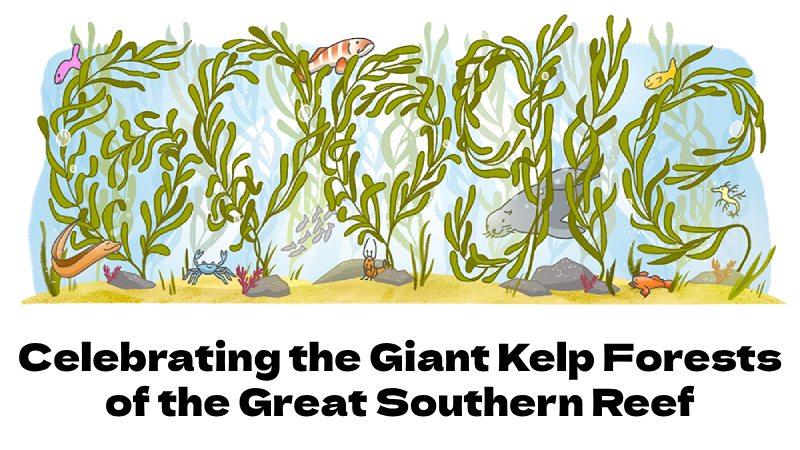
Today’s Google Doodle honors the Great Southern Reef’s giant kelp forests, an endangered natural wonder that extends over 8,000 kilometers below Australia. The Great Southern Reef stretches over Tasmania’s and Australia’s southern coasts and is home to giant kelp forests, which are celebrated in this Doodle. On December 5, 2019, Mission Blue officially designated the Great Southern Reef as a new Hope Spot.
Today’s Google Doodle highlights the Great Southern Reef’s Giant Kelp Forests. Off the coast of Australia lies this enormous underwater forest. Numerous marine animals call it home, including fish, sea otters, and sea urchins. Visitors come from all over the world to dive and snorkel in its clear waters.
One of the planet’s most unique ecosystems is the Giant Kelp Forests. Both people and marine life depend on them, and they have a great biodiversity. For the sake of future generations, this natural wonder must be preserved. Google Doodle exquisitely depicted the kelp forest’s towering plants and vibrant marine life.
The doodle includes a link to a video about the kelp forest which provides additional information about this special ecosystem. The Giant Kelp Forests remind us of the richness and beauty of our planet by the Giant Kelp Forests. They are treasures that should be looked for and preserved for many years to come.
Tropical coral reefs, such as the Great Barrier Reef, the famous neighbor of the Great Southern Reef, are most likely what most people envision when they think of reefs. Australia is more than 8,000 kilometers below the Great Southern Reef. Its rocky reef structure is joined with kelp, a seaweed that grows quickly and has a leaf-like appearance. Seafloor creatures like stingrays, spider crabs, and rock lobsters find refuge in kelp, which grows well in cold, slow-moving water.
The beautiful ecosystem of the Great Southern Reef attracts scuba divers and ocean lovers from all over the world. The biggest threat to this natural wonder is climate change. The reef is situated on top of two regions where the pace of ocean warming has been exceptionally high. One technique being used in marine restoration efforts is upscaling, which involves establishing self-sustaining seed patches that grow in the former kelp habitat.
Let’s keep this natural wonder intact!
An interview on the writing behind selected works. Msb Mario, also known as “El Niño… Read More
A startup launch involves more than announcing that a company exists. Prospective customers need to… Read More
Few hospitals are short on data. Claims, quality measures, staffing reports, patient-experience surveys, and payer… Read More
A roof rarely fails all at once. It starts with a few lifted shingles after a windy… Read More
Spotify revealed on Wednesday that it is broadening audiobook availability to more than 180 markets… Read More
A family business proves its relevance each time a new generation finds something worthwhile to… Read More
