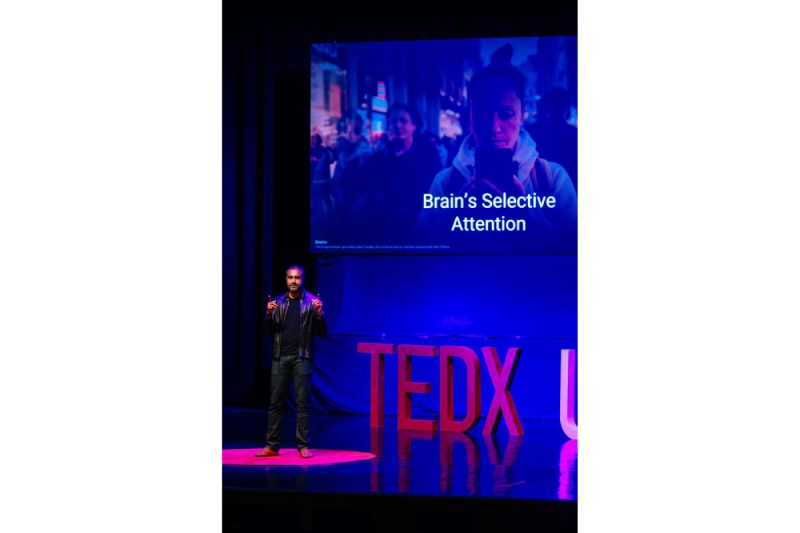
Rana Gujral, CEO of Behavioral Signals, an AI startup focused on cognitive AI, delivered a compelling TEDxUPV talk, “The Brain’s Dream: How Our Minds Shape Reality,” uploaded to the TEDx YouTube channel on March 3, 2025 (https://youtu.be/gcV1um7kOMw?si=AlBSfwO9UOSBpDI). A Forbes Technology Council member and seasoned entrepreneur, Gujral leverages his deep learning expertise to explore how our brains construct reality. This article examines two central themes from his talk—the brain as a shaper of perception and the self as a neural construct—focusing on their scientific grounding and ties to Gujral’s work, while presenting a clear, well-crafted narrative.
Rana Gujral: From AI Innovation to TEDx Insights
Gujral introduces himself as an entrepreneur leading Behavioral Signals, where he develops AI to analyze human behavior through voice data. With leadership roles at Logitech, UKG and Cricut, Gujral’s experience in AI and cognition informs his TEDx talk. Delivered in a conversational style, the talk uses neuroscience and optical illusions to question how we perceive reality, showcasing his ability to distill complex ideas into engaging insights.
The Brain as Perception’s Architect
Gujral challenges the notion that our eyes capture reality like a camera. “Your brain doesn’t just receive what your eyes see—it creates a production,” he says, citing David Eagleman’s The Brain: The Story of You. He illustrates this with the Checker Shadow Illusion, where two identical squares appear different due to context, as shown in Edward Adelson’s research. The Hollow Mask Illusion further highlights this: a concave mask appears convex because the brain expects faces to protrude, per Richard Gregory’s *The Intelligent Eye*. “Even when you know it’s an illusion, your brain insists,” Gujral observes, emphasizing neural expectations over sensory input.
This extends to all perception. Colors like “red” are brain interpretations of light wavelengths, not inherent properties, as Semir Zeki’s *Inner Vision* notes. Selective attention, per Anne Treisman’s studies, filters out irrelevant details, crafting a tailored reality. Gujral connects this to his AI research at Behavioral Signals, where neural networks detect universal emotional patterns across languages, suggesting the brain relies on shared mechanisms to build perception. This perspective underscores that our reality is actively constructed, aligning with his work on human behavior.
The Self as a Neural Construct
Gujral’s second theme questions identity. “The ‘you’ inside your head might be an illusion,” he suggests, referencing Sam Harris’s *Waking Up* and David Hume’s *A Treatise of Human Nature*. The self, he argues, emerges from neural connections, not a fixed entity. Memory shapes this, as Elizabeth Loftus’s research on memory reconstruction shows: past experiences create a cohesive identity, akin to how the brain constructs visual reality. The Hollow Mask Illusion parallels this—expectations shape not just what we see but who we think we are.
Gujral concludes by asking, “What is reality, really?” Rooted in his AI insights, this question resonates with psychology and technology, where perception is key. Blending science and accessible examples, his talk invites us to explore the mind’s role in shaping our world, offering a nuanced view of reality and self.
Renovating a building that people still use is a balancing act. Owners want to improve… Read More
Live dispatch keeps a fire watch running at every hour by giving each guard a… Read More
Once your parents turn 60, renewing the family's medical cover raises a real question. Do… Read More
By Credible Law, a legal information and attorney referral resource for business owners navigating merchant… Read More
For years, owning a home in prime central London was treated as almost self-evidently sensible.… Read More
An electric bike may cost less to run than a petrol model, but repairs can… Read More
