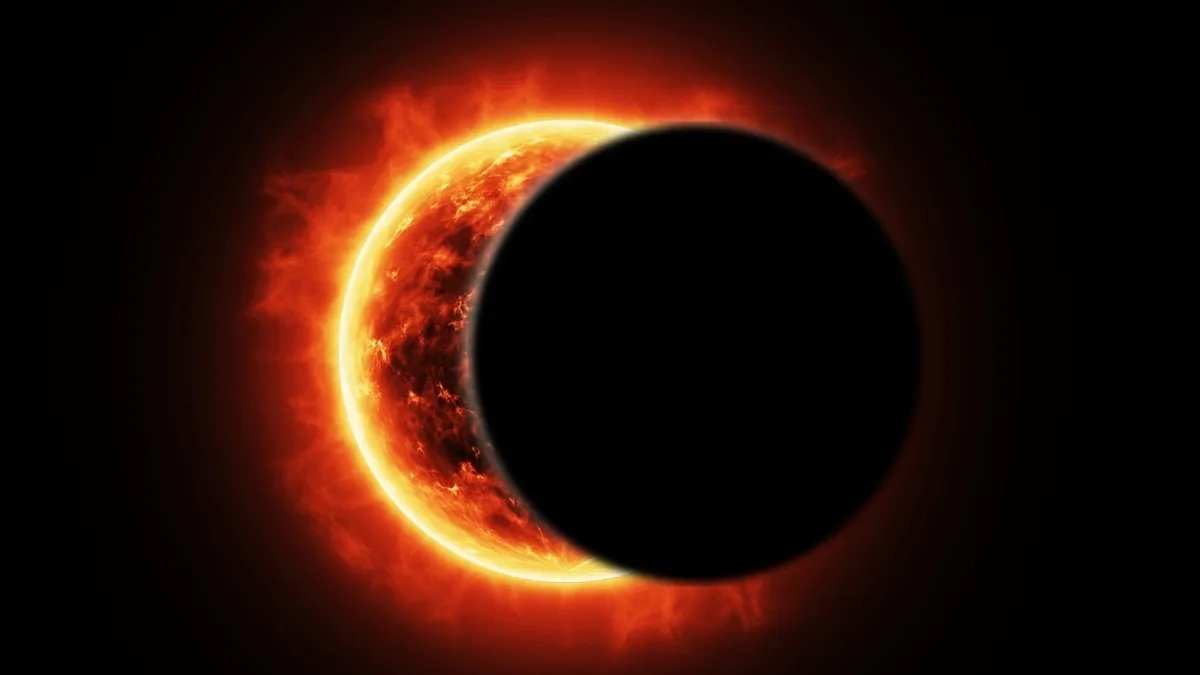
The last solar eclipse of 2025 takes place on September 21, which is one day before the equinox. New Zealand, Antarctica, and the South Pacific will all be able to see the partial solar eclipse. The last solar eclipse of 2025 will not be visible to many people in the Northern Hemisphere, including India, but observers in Australia and New Zealand will be treated to a rare sunrise treat.
The cosmic calendar has a fresh month and a new celestial event. A solar eclipse in September 2025, a few weeks after the spectacular Blood Moon lunar eclipse, is the last spectacle in the sky. However, on September 21, a stunning “crescent sun” will only be visible to a select few people worldwide. It indicates that the solar eclipse that is coming up will only be partial. You will learn here when and where the last solar eclipse is expected to occur in 2025 based on a number of scientific reports. In this manner, you can be completely ready for the year’s last astronomical event.
This September, Southern Hemisphere stargazers will have a unique opportunity. The last solar eclipse of 2025 will occur on the 21st, right before the equinox. Is it safe to see this celestial event, and how will it look around the region?
With the moon obscuring up to 86% of the sun, this is a deep partial eclipse rather than a total one! The best views will be seen from research stations in Antarctica and southern New Zealand, although several Pacific islands will also be shown.
Due to its unusual timing, the eclipse takes place just before the September equinox, which marks the beginning of spring in the Southern Hemisphere and fall in the Northern Hemisphere.
Keep in mind that without certified solar eclipse glasses, it is never safe to gaze directly at the sun. Appropriate eye protection is essential even during the partial phases.
Farther east, coverage diminishes; at sunset, the Antarctic Peninsula will only see a 12% eclipse.
The easiest views are found in New Zealand. At sunrise, the eclipse will already be in progress, producing spectacular crescent-shaped dawns.
Smaller but still noteworthy eclipses will occur in island nations:
The last partial solar eclipse of 2025 will occur on September 21. It will provide breathtaking views from Antarctica, New Zealand, and the South Pacific right before the equinox.
In contrast to a total solar eclipse, in which the Moon totally obscures the Sun, a partial solar eclipse merely covers part of the Sun’s disk. A dazzling crescent of sunshine remains visible as a result. Since the moon will be obstructing up to 72% of the sun in some places during the deep partial eclipse on September 21, 2025, the event is important. This implies that those in its path will see a breathtaking visual display and have a rare opportunity to view the functioning of the solar system in real time.
The Southern Hemisphere will be seeing a solar eclipse on September 21. Here’s a breakdown of the key times and locations, with all times in UTC:
Antarctica, New Zealand, and parts of the South Pacific will be covered by the partial solar eclipse. The moon will obscure a large portion of the sun, according to observers at Antarctic research stations and southern New Zealand.
For example, there will be a 60% eclipse in Auckland and a 69% eclipse in Christchurch. Wellington will see 66% and Invercargill up to 72%. Will the view of island nations be favorable? A 32% eclipse will be seen in Tonga, 27% in Fiji, 23% in the Cook Islands, and 17% in Samoa.
Eclipse coverage varies greatly in Antarctica. Just 5% occurs at Marambio Base, 72% at Mario Zucchelli Station, and 69% at McMurdo Station. About 65% of the Ross Ice Shelf will be eclipsed as the sun sets, compared to only 12% on the Antarctic Peninsula.
What time does the eclipse on September 21 start? At sunrise in New Zealand, the eclipse is already underway, creating spectacular crescent dawns. It is essential to use proper eye protection because it is never safe to look directly at the sun, even during partial phases. All spectators are required to wear certified solar eclipse glasses.
Will the eclipse be visible in India? Sadly, India will not be able to see the eclipse because it is outside its path.
The following are the pivotal points in Coordinated Universal Time (UTC):
When converting to Indian Standard Time (IST), the time difference would be approximately 10:59 p.m. IST on September 21 to 3:23 a.m. IST on September 22.
What makes this solar event special? When the sun crosses the celestial equator, it happens right before the September equinox. In the southern hemisphere, this is spring; in the northern hemisphere, it is fall. The moon will obscure up to 86% of the sun, making it a deep partial eclipse even if it is not a total eclipse. The last solar event of 2025 is the eclipse on September 21, which offers stunning views as the year draws to a close.
Enthusiasts should bring cameras and safety equipment, whether they want to watch in person or online. To securely and attractively capture the moment, there are astrophotography camera recommendations and solar eclipse photography instructions available.
This is 2025’s last solar eclipse. It coincides closely with the equinox in September, when day and night are about equal everywhere. Increases the level of interest.
For those who follow astrology or rituals, it coincides with the Hindu calendar’s Pitru Paksha/Shraddh era. However, traditional observances like Sutak are typically not observed in India because they won’t be apparent.
Never look directly at the sun during a solar eclipse without the proper eye protection if you’re on the visibility path. Use a pinhole projector or only approved solar eclipse glasses.
Standard sunglasses can harm your eyes permanently and are unsafe to use, even if they are extremely dark. To securely watch the event from anywhere on the planet, you can also watch live streaming from official sources like NASA.
This year’s last solar eclipse serves as a stunning reminder of the universe’s powerful and dependable cycle. As a fitting conclusion to a year full of celestial delights, the show may not be seen by everyone, but for a few, it promises to be an unforgettable display of cosmic choreography.
For those in regions where this eclipse will be visible, even if India won’t be able to witness it:
Google is introducing the standalone Gemini Enterprise app for Android, which will deliver its corporate-grade… Read More
Digital payments have changed how we handle money. Whether you are paying for a small… Read More
Taking care of your health and well-being doesn’t have to mean dramatic changes or strict… Read More
We often talk about growing up as if emotions mature on a perfect timeline, children… Read More
Image source: Critical Training Solution Emergency management requires a structured yet flexible approach to handle… Read More
Strategic philanthropy is transforming how individuals and organizations approach donations. Rather than making spontaneous contributions,… Read More
