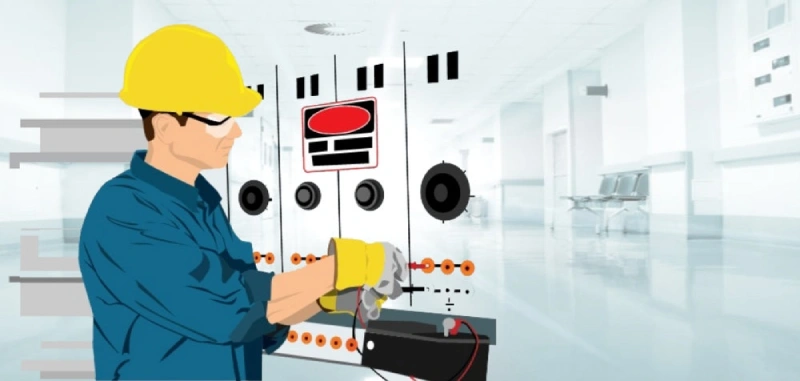
Safety is the number one job for every individual, including employees and employers in the workplace. Security is particularly important for those who install and service electrical systems. It is quite disheartening if a loved one dies or suffers irreparable damage from electrical hazards. No matter the parameters put in place for safety, it is still the worker’s responsibility to prevent and protect themselves from electrical hazards. Electrical hazard has always been recognized, but many people suffer from loss and damage annually.
According to statistics, 95% of electricians have been shocked or injured during the job. Electrocution is one of the leading causes of occupational hazards. There is an obligation to protect people, especially electricians, from the danger of electricity. When there is a problem with the electrical system, it is subjected to thermal and magnetic force. These two forces can lead to damage to the system and the equipment. Most times, it is usually accompanied by explosions, fire outbreaks, and other hazards. Some of these hazards may lead to people’s death around the area or even personnel working with the system. Also, it can shut down a plant.
With all these life-threatening hazards involves in the electric system, there is a need to educate people and personnel on safety to prevent future threats. To better understand electrical safety, there is a need to understand electricity itself. Electricity is defined as the free movement of electrons in an electrical circuit, and the electrical current is measured in amperes.
An electrical hazard is a situation where a worker or individual comes in contact with an energized electric equipment or conductor. This may lead to the sustenance of injury or possible death, which may result from shock, arc flash, and thermal burn.
The different types of hazards that may result from an electrical accident
There are different causes of electric hazards, but the three major ones are listed below
The electrical power system is a complex and integrated system that involves the generation, distribution, and transmission of electrical current. These are processes that are bound to develop faults due to some factors. An electrical fault can be defined as an abnormal condition that may result from equipment failure, environmental conditions, and human errors. In other words, it can be defined as an abnormal condition of the electrical system, which damages the electrical equipment and interrupts the normal flow of electric currents. This fault leads to a reduction in insulation strength between phase conductors and earth.
Knowing the type of electrical faults gives the idea of what you are dealing with if you encounter any of them. Fault detection and analysis provide a picture of the possible solution to any of these faults and how they can lead to an electrical hazard. Flaws lead to the deviation of voltages and current from the standard states. Electrical faults can be categorized into two:
Open circuit Fault: available fault usually results from the failure of one or two conductors. It is also known as the series fault because it takes place in series with the line. The open-circuit fault is further divided into three:
Short Circuit fault: this is the most common and dangerous type of electrical fault, also known as shunt fault. This occurs when short-circuit current flows through the circuit and leads to damage to the insulation between phases. Short circuit fault can further be categorized into two
Symmetrical fault: this type of defect is not shared, and when it occurs, it results in severe damage to the electrical system equipment. Symmetrical faults occur mostly at terminal generators. It may arise due to resistances of the arc between the conductors; it is also a fault that involves all three phases. The symmetrical fault is further classified into two:
Three-phase to ground Fault: this type of fault occurs due to the breakdown of insulation between all three steps. It rarely happens, but when it does can be severe.
Three-phase short-circuited: it occurs due to the breakdown of insulation between all the three phases. The occurrence rate is about 2-3% in a power system. It is the most severe fault that involves large currents.
Unsymmetrical fault: this type of fault is prevalent, and they are less severe than a symmetrical fault. It occurs due to the current difference in magnitude and phases; an unbalancing of the system. They are majorly classified into three:
The line ground Fault: this is the most frequent fault in the electrical power system. it occurs due to insulation breakdown between the line and the earth
Line-to-Line fault: it occurs due to heavy wind; it occurs when two conductors are short-circuited. The heavy wind may cause the two conductors to touch each other, leading to a short circuit.
Double Line-to-Line Ground Fault: it occurs when there is a breakdown of insulation between two phases and simultaneously an analysis of insulation between the third.
This is general practice and precautions to prevent electrical hazards
In Dubai’s really competitive real estate scene, building a reputation that rests on trust, consistency,… Read More
Czechia and South Africa endured disappointing starts to their FIFA World Cup campaigns, with both… Read More
After missing out on AFCON 2025, Ghana will be eager to respond on football’s grandest… Read More
England and Croatia face off at Dallas Stadium in Arlington in their opening group-stage fixture… Read More
Cristiano Ronaldo’s Portugal get their 2026 World Cup campaign underway against DR Congo in Houston… Read More
Adobe has introduced updates to five Creative Cloud applications in a single release. Lightroom’s Assisted… Read More



