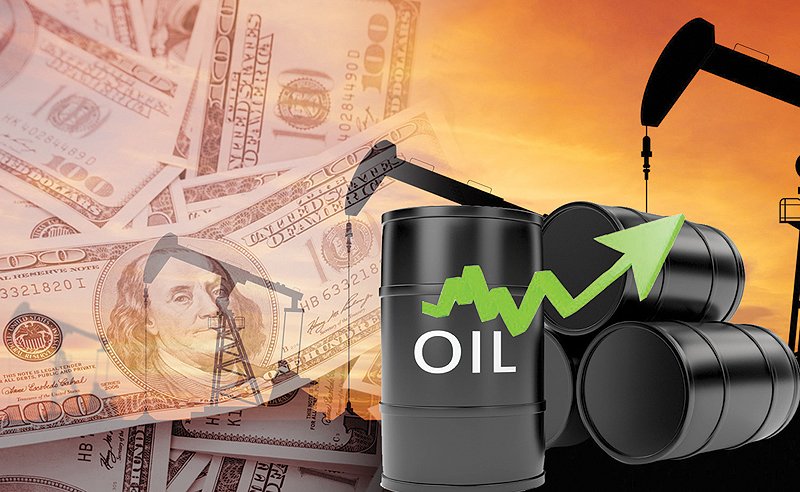
Oil prices soared as a result of the surprise cut in production that OPEC and its allies made. Analysts say that major oil importers like India, Japan, and South Korea will suffer the most if prices reach $100 per barrel, as some have predicted.
Oil markets were surprised when OPEC+ announced a production cut of 1.16 million barrels per day on Sunday.
Private investment bank Raymond James managing director Pavel Molchanov stated, “It’s a tax on every oil-importing economy.”
“It’s not the U.S. that would feel the most pain from $100 oil, it would be the countries that have no domestic petroleum resources: Japan, India, Germany, France … to name some of the big examples,” Molchanov said.
The willful cuts by countries in the oil cartel are set to begin in May and last till the finish of 2023. Both Saudi Arabia and Russia will manage oil creation by 500,000 barrels each day for the rest of this current year, while other OPEC members like Kuwait, Oman, Iraq, Algeria, and Kazakhstan additionally diminish output.
At the time of writing, Brent crude futures were up 0.57 percent to $85.41 per barrel, while U.S. West Texas Intermediate futures were up 0.5 percent to $81.11 per barrel.
“The regions most hit by the oil supply cut and related crude price jump are those with a high degree of import reliance and a high share of fossil fuels in their primary energy systems,” said the director of Eurasia Group, Henning Gloystein.
“That means the most exposed are import-reliant emerging market industries, especially in South and Southeast Asia, as well as the super-import dependent heavy industries of Japan and South Korea.”
Since Russia was sanctioned for its invasion of Ukraine, India, the third largest oil consumer in the world, has been purchasing Russian oil at a significant discount.
India’s crude oil imports increased by 8.5% in February compared to the same period last year, according to government data.
Gloystein stated, “Although they are still profiting from discounted Russian gas, they are already hurting from high coal and gas prices.”
“If oil goes up further, even the discounted Russian crude will start to hurt India’s growth.”
Around 40% of Japan’s total energy supply comes from oil, making it the most important energy source.
The International Energy Agency stated, “Having no notable domestic production, Japan is heavily dependent on crude oil imports, with between 80 and 90 percent coming from the Middle East region.”
Additionally, oil accounts for the majority of South Korea’s energy requirements, according to the independent research organization Enerdata.
Molchanov made the observation that “South Korea and Italy are more than 75% dependent on imported oil.”
Gloystein claims that Europe and China are also “highly exposed.”
He added, however, that China’s exposure was slightly lower due to domestic oil production, whereas Europe’s primary energy mix primarily consists of nuclear, coal, and natural gas rather than fossil fuels.
According to Molchanov, the $100 price tag will hurt some emerging markets that “do not have the foreign currency capability to support these fuel imports.” He named Argentina, Turkey, South Africa and Pakistan as potential economies that will be hit.
He stated that Sri Lanka, which is entirely dependent on imports and does not produce its own oil, is also extremely vulnerable to a greater blow.
Amrita Sen, the founder of Energy Aspects, stated, “Countries with the least foreign currencies and who are importers will hurt the most because oil is priced in the U.S. dollar.” She added that the cost of imports would rise even further if the greenback appreciates.
Molchanov, however, stated that although $100 per barrel may be on the horizon, the higher price point may not last long and will not be “the permanent plateau.”
He stated that “in the long run, prices could be more kind of in line with where we are today”—around $80 to $90.
According to Gloystein, “Once crude hits $100 a barrel and stays there for a bit, that incentivizes producers to really ramp up output again.”
The top athletes in U.S. collegiate track and field will compete for national championships at… Read More
Apple today introduced Siri AI, an all-new version of Siri driven by Apple Intelligence. Designed… Read More
The FIFA World Cup has yet to officially begin, but Toronto is already preparing to… Read More
Explore custom Wonder White Marble processing for large-scale architectural projects. Achieve consistent quality, precise finishes,… Read More
Disney+ has officially confirmed its third Star Wars film and television release set to arrive… Read More
June is usually a relatively quiet period on the NFL calendar, but the 2026 offseason… Read More
