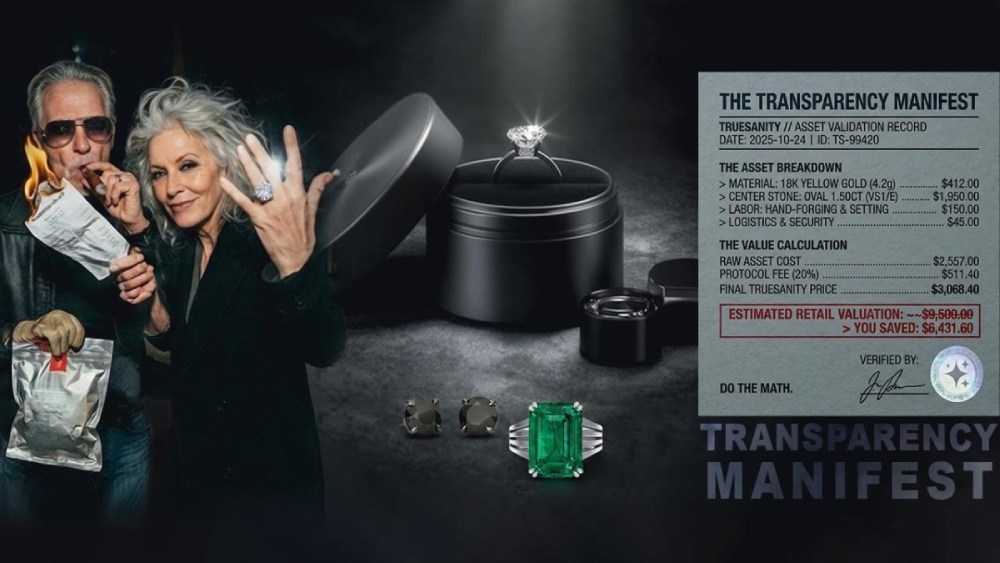
If you scroll through the Instagram feeds of the recent engagement rings, you will notice a glitch in the algorithm. The soft-focus, pastel-pink “Princess Proposal” is vanishing. In its place is something darker, harder, and infinitely more real.
Grainy flash photography in the back of a taxi. A couple running through the rain in leather jackets. And on her finger, not a traditional white solitaire, but a deep, absorbing void of a Black Diamond Ring or the untamed green chaos of an Emerald Ring.
This is “Nocturnal Bridal.” And the brand fueling this rebellion is TrueSanity.
“The jewelry industry has been selling you a lie for a hundred years,” says Amit Jhalani, the founder of TrueSanity, who prefers the title ‘The Architect.’
We meet in his NYC headquarters, which feels less like a showroom and more like a tactical command center. The walls are dark concrete. The lighting is clinical. There isn’t a velvet rope or a glass of champagne in sight.
“The lie is that ‘tradition’ costs money,” Jhalani says, his voice flat and serious. “The Cartel, the heritage brands on 5th Avenue, created a fairy tale to hide their margins. They want you to believe that if you don’t spend three months’ salary on a flawless white diamond, you don’t love her. It’s open warfare on your bank account. And we are here to end it.”
For a generation defined by economic volatility and a rejection of performative perfection, the standard white diamond feels… sterile.
“White diamonds are about purity,” says Jhalani. “But modern love isn’t pure. It’s messy. It’s intense. It’s survival. That’s why we sell ‘Protocol: Void’ (Black Diamond Rings) and ‘Protocol: Verdant’ (Emerald Rings). These stones have character. They have flaws. They look like armor.”
TrueSanity’s aesthetic matches this philosophy. Their rings don’t come in ribbon-wrapped boxes. They arrive in Aerospace Aluminum Cylinders, vacuum-sealed in silver Mylar evidence bags. The unboxing experience feels like receiving a classified asset, not a gift.
But the rebellion isn’t just aesthetic; it’s financial. TrueSanity creates what they call “The Glitch” in the market by exposing the raw cost of every item.
On every order, true sanity gives out a “Transparency Manifest”, a receipt that breaks down the price of a ring: Gold Cost, Labor, Stone Cost, and their flat “Protocol Fee.”
“When you buy from the mall, you pay a ‘Mall Tax’ of 300% to cover their rent and their sales commissions,” Jhalani explains. “We stripped the machine. We don’t have salespeople. We have algorithms and artisans. You pay for the metal and the stone. Nothing else.”
TrueSanity is betting that the future of luxury isn’t about aspiration; it’s about intelligence. It’s for the couple that would rather invest in a house than a brand name. It’s for the lovers who find beauty in the dark, not just the light.
“Let the old guard keep their fairy tales,” Jhalani says, inspecting a finished black diamond ring with a loupe. “We’ll keep the truth.”
The USC Trojans are returning to the NCAA Tournament, but their journey toward Omaha will… Read More
ZAGREB, Croatia | Croatia’s digital finance sector continues to evolve rapidly in 2026, and one… Read More
Skywatchers are in for a rare celestial event at the end of May as 2026… Read More
Demon Slayer: Kimetsu no Yaiba Infinity Castle claimed the film of the year honor at… Read More
Spotify has introduced a new AI-driven tool for self-publishing audiobooks through its Spotify for Authors… Read More
In a world where many people dream of building luxurious homes for comfort and status,… Read More
