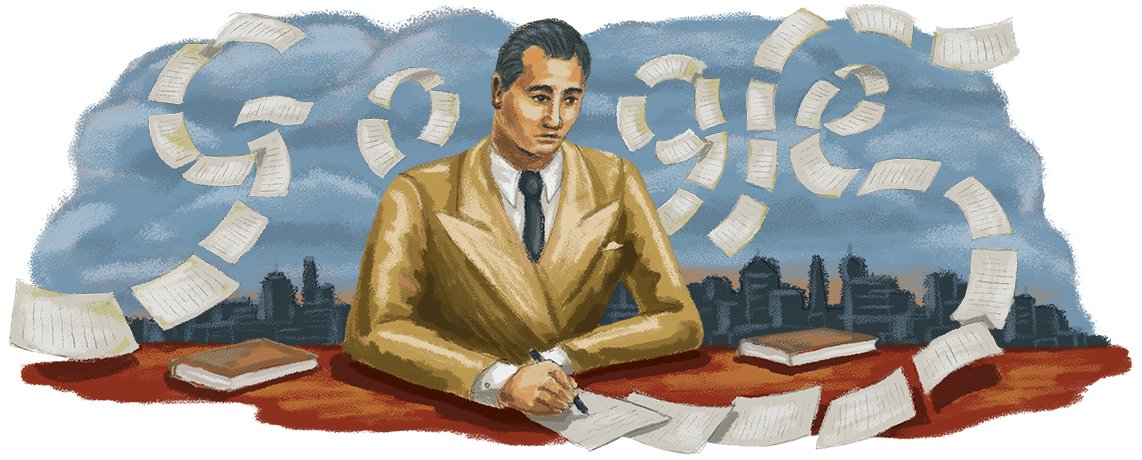
Google Doodle praises the 113th birthday celebration of Jewish-Romanian playwright, journalist, and novelist Mihail Sebastian, on October 18, 2020.
Born as Iosif Mendel Hechter on October 18, 1907, to a Jewish family in the Romanian port town of Brăila. Mihail Sebastian was a Romanian playwright, essayist, journalist, novelist, and lawyer.
In the wake of completing his secondary studies, Mihail Sebastian proceeded to study law in Bucharest, however, was soon pulled in to the literary life and the exciting thoughts of the new generation of Romanian intellectuals, as typified by the literary group Criterion which included such illuminating presences as Emil Cioran, Mircea Eliade, and Eugène Ionesco.
Mihail Sebastian published a few novels, including Accidentul (“The Accident”) and Oraşul cu salcâmi (“The Town with Acacia Trees”), vigorously affected by French novelists, for example, Marcel Proust and Jules Renard.
As a Jew, Mihail Sebastian came to be viewed as an outsider within the group, even by his companions. In 1934 he published another novel, De două mii de ani (For Two Thousand Years), about what it intended to be a Jew in Romania.
In light of the analysis, Sebastian composed Cum am devenit huligan (How I Became a Hooligan), an anthology of essays and articles portraying how For Two Thousand Years was gotten by the Romanian public and the nation’s cultural foundation.
Mihail Sebastian became known in Romanian literature fundamentally for his plays, for example, Steaua fără nume (“The Star Without a Name”), Jocul de-a vacanţa (“Holiday Games”, 1938), and Ultima oră (“Breaking News”).
For a decade, Sebastian kept a journal that was at last published in Bucharest in 1996 to “considerable debate” and in America under the title Journal, 1935-1944: The Fascist Years.
Mihail Sebastian was an extraordinary admirer of classical music and often went to concerts. In his Journal, there are numerous references to different classical composers and reviews of radio broadcast concerts.
In the wake of being kicked out of his home because of the new anti-Jewish laws, Mihail Sebastian moved into a tenement slum where he proceeded with his writing.
Mihail Sebastian was hit by a truck and died on May 29, 1945.
In 2006, Mihail Sebastian was posthumously awarded the Geschwister-Scholl-Preis for his historic and courageous journals, Voller Entsetzen, aber nicht verzweifelt.
Mihail Sebastian’s 1934 novel “De două mii de ani” (“For Two Thousand Years”) and his journals “Journal 1935-1944″– posthumously published in 1996–are today viewed as original chronicles of the ascent of anti-Semitism in 20th-century Europe.
On October 18, 2020, Google observes Mihail Sebastian’s 113th Birthday with a Google Doodle.
A family business proves its relevance each time a new generation finds something worthwhile to… Read More
Sometimes, the biggest opportunities begin when you realize you have outgrown where you are. For… Read More
Apple started introducing Apple Pay in India on Tuesday. Axis Bank, the country's third-largest private-sector… Read More
As all-in-one AI agents such as Meta’s Muse and Instinct gain momentum, Google has announced… Read More
Major League Baseball's 2026 postseason begins Tuesday, Sept. 29 with four best-of-three wild card series,… Read More
A Career Built on Authentic Beauty For more than 30 years, Brigitta Würfl has built… Read More

