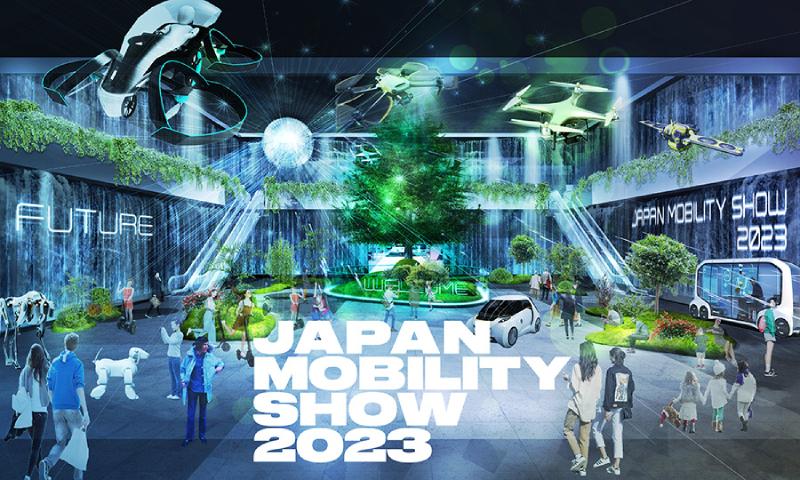
Japan Mobility Show, the rebranded Tokyo Motor Show’s successor, opens to the public on Thursday with the goal of attracting one million visitors.
This week’s Japan Mobility Show puts pressure on domestic automakers to demonstrate that they are committed to not just becoming carbon neutral but also to completely transforming the way that goods and people are transported.
It has long been a point of criticism for Japanese automakers such as Toyota Motor Corp., Honda Motor Co., Nissan Motor Co., and others not to quickly phase out gasoline-powered vehicles.
To demonstrate that they are prepared and able to increase the frequency of battery-powered car sightings on the nation’s roads in the years to come, they will be sprinkling the show floor with electric vehicle concepts this week.
According to BloombergNEF, battery-electric cars made up only 1.5% of new car sales in Japan in 2022, far less than in other developed nations. In contrast, nearly one in five newly sold vehicles in China—which earlier this year overtook the United States as the world’s largest auto exporter—were battery-electric.
The rebranded Tokyo Motor Show, which debuted in 1954 and lasted until 2019 with 1.3 million visitors before taking a break due to the pandemic, opens for business this Thursday. One million visitors is the target this year, according to the organizers.
For an extended period, Japanese automakers such as Toyota, Honda, Nissan, and others have faced criticism for their reluctance to gradually phase out gasoline-powered vehicles. In an attempt to demonstrate their willingness and ability to increase the frequency of battery-powered car sightings on the nation’s roads in the years to come, they will be sprinkling electric vehicle (EV) concepts throughout the show floor this week.
According to BloombergNEF, battery-electric cars made up only 1.5% of new car sales in Japan in 2022, far less than in other developed nations. In contrast, China, which earlier this year emerged as the world’s leading automobile exporter, saw nearly one in five of the new cars sold there be battery-electric.
“There’s a strong concern that the growing costs of energy and labour will make it difficult to manufacture in Japan, let alone sell cars,” said Masami Tanaka, director general of the Japan Automobile Manufacturers Association’s Next-Generation Mobility Division. “Key industries need support for the sake of the country’s economic growth.”
The leading automakers in Japan were among the first to employ gas-electric hybrid powertrains; however, they now believe that regional variations and a longer timescale will be required for the global EV transition. They have supported a variety of strategies for cutting emissions, which has incensed environmental advocacy groups.
Though nearly 500 companies have registered for the event this week, just three foreign automakers—China’s BYD Co., the leader in electric vehicles, and Germany’s Mercedes-Benz Group AG and BMW AG—will be on display.
Non-Japanese automakers are not exempt from the lack of EV adoption in Japan; despite the introduction of fully electric vehicles by Mercedes-Benz, BYD, and Hyundai Motor Co., early sales have been slow. Tatsuo Yoshida, senior auto analyst at Bloomberg Intelligence, finds little room for Chinese brands like BYD to expand in the nation.
According to Yoshida, “The mobility show is a good opportunity to better understand their business strategy.”
In keeping with its position as the centerpiece of the automaker’s electrification strategy, which was unveiled earlier this year, Toyota’s luxury brand Lexus will present a lineup of battery-electric concept cars. Concepts for electric vehicles under the Toyota brand will include the FT-3e, a sporty SUV, and the FT-Se, a sports car with shared major components.
Four EV concepts—the Hyper Urban crossover, Hyper Adventure off-roader, Hyper Tourer minivan, and Hyper Punk compact—whose angular, outlandish designs have been revealed by Nissan.
Suzuki Motor will unveil a compact electric wagon, and Honda, Subaru, and Toyota will all showcase their electric sports car concepts.
The majority of Japanese automakers have pledged to boost EV production and lower the emissions of their lineup, but they haven’t yet created high-volume models to rival Tesla or BYD. It’s unlikely that these cars will go on sale in large quantities until at least 2025.
BTS, Cardi B, and Lainey Wilson are among the artists scheduled to perform at the… Read More
The 2026 World Cup is shaping up to be the tournament of excess. The largest… Read More
Most people are taught to believe success has a deadline. That dreams should be achieved… Read More
South Portland functional medicine clinic reaches milestone amid growing demand for personalized, root-cause healthcare SOUTH… Read More
The 2026 NCAA Division I Baseball Championship gets underway Friday as teams across the country… Read More
Spotify is rolling out several significant updates to its mobile app, including Android support for… Read More
