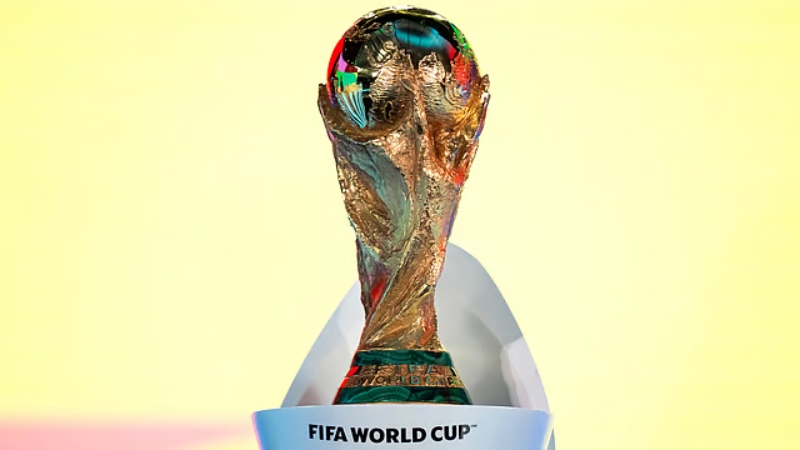
The 2026 World Cup is shaping up to be the tournament of excess. The largest FIFA World Cup ever will begin on June 11 in North America, and it will differ significantly from previous editions for numerous reasons. The question remains: does bigger truly mean better?
The answer will emerge soon enough.
For the first time in World Cup history, the tournament will be staged across three countries.
Since its inaugural edition in 1930, the competition has generally been hosted by a single nation, although one previous tournament was shared between two countries. In 2002, South Korea and Japan jointly hosted the World Cup.
While the United States possesses sufficient infrastructure to organize the entire event on its own, as it did in 1994, CONCACAF submitted a combined bid with Canada and Mexico in 2016.
There was also very little competition for hosting rights. Because the 2018 World Cup took place in Russia and the 2022 edition was held in Qatar, both Europe and Asia were excluded from hosting the 2026 tournament. As a result, Morocco was the only rival bid challenging North America’s proposal.
When voting took place at the 2018 FIFA Congress, CONCACAF secured a decisive victory. The joint North American bid received twice the number of votes earned by Morocco.
When Mexico’s opening match against South Africa kicks off in Mexico City on June 11, the nation will officially become the first country ever to host three World Cups. Mexico previously hosted the tournament in 1970 and again in 1986. While the United States is hosting its second World Cup, Canada’s match against Bosnia-Herzegovina in Toronto on June 12 will mark the first World Cup game ever played on Canadian soil.
One major reason the tournament is spread across such a vast area is the expansion of the competition. The 2026 World Cup is considerably larger than the 2022 edition and twice the size of the tournament hosted by the United States in 1994.
The field has expanded from 32 teams to 48, allowing many more nations to qualify. Countries such as Jordan, Uzbekistan, Curacao, and Cape Verde will make their World Cup debuts, while Scotland and Norway return for the first time since 1998, and Haiti qualifies for its first appearance since 1974.
The World Cup has expanded steadily over the decades. The first tournament in Uruguay in 1930 featured 13 teams. The competition grew to 16 teams in 1934, although the 1938 edition included only 15 teams after Austria became part of Germany, while the 1950 tournament featured 13 teams after three nations withdrew.
In 1982, the World Cup expanded to 24 teams and remained at that size through the 1994 tournament in the United States. Four years later, it increased to 32 teams.
More teams result in more matches and greater revenue for FIFA, meaning the 48-team format is expected to remain in place. The competition will not revert to 32 teams for either the 2030 or 2034 tournaments. It is also possible that the event could become even larger in the future.
Under the previous 32-team format, reaching the knockout rounds was relatively straightforward. Eight groups of four teams competed, with the top two teams from each group advancing to the Round of 16.
However, with the addition of 16 more teams, the knockout phase has expanded to 32 teams. The tournament will now feature a total of 104 matches, compared to 64 matches during the 2022 World Cup.
There are now 12 groups consisting of four teams each, and every nation will still play at least three group-stage matches. The top two teams from every group will advance automatically, while the remaining eight places in the Round of 32 will be awarded to the eight best third-place finishers across the 12 groups.
This means it will be more difficult for a nation such as Germany to miss out on the knockout rounds, as happened in 2022. Germany finished third behind Japan and Spain in Group E but collected four points and maintained a positive goal difference. A performance of that level would likely be enough to secure advancement in 2026.
With third-place teams now capable of progressing and goal difference serving as a crucial tiebreaker for those final Round of 32 positions, teams are expected to place an even greater emphasis on defensive organization during the group stage, particularly smaller nations. Although the gap in quality between the strongest and weakest teams remains substantial, more countries having a realistic chance of qualifying could encourage more cautious tactical approaches.
Many World Cup venues are expected to experience hot and humid conditions, especially given that the tournament will be played during the summer months.
Although five stadiums feature either full or retractable roofs, every World Cup match will include multiple scheduled hydration breaks for players.
This represents an unprecedented step for a sport known for uninterrupted action during each half. FIFA announced in December that both halves would include a three-minute stoppage to “prioritize player welfare.” These breaks will occur 22 minutes into each half.
Hydration breaks themselves are not new and have frequently been used during matches played in extreme temperatures. However, scheduling them for all matches, including those played in cooler conditions or inside covered venues, is something that has never been done before.
The breaks also create additional advertising opportunities for Fox and other global broadcast partners. In March, FIFA stated that broadcasters would be permitted to air commercials during the stoppages, provided they begin 20 seconds after the break starts and conclude 30 seconds before play resumes. This effectively provides approximately two minutes of advertising time and room for up to eight additional 30-second commercials during every match.
The hydration breaks are unlikely to be the only interruptions during matches. Although the 2026 tournament is not the first World Cup to use Video Assistant Referee technology, officials will have expanded replay-review authority compared to four years ago.
In addition to reviewing potential handballs, possible red-card incidents, and penalty decisions, VAR officials will now be able to determine whether corner-kick or goal-kick decisions were incorrect, provided the error is deemed “clear and obvious.” Naturally, the definition of “clear and obvious” remains one of football’s most debated and subjective phrases. Expect to hear it frequently throughout the tournament and perhaps question its meaning by the time the competition concludes.
Match officials may also be instructed to review the validity of a second yellow card shown to a player. As a reminder, receiving two yellow cards in the same match results in an automatic dismissal and leaves a team playing with 10 players for the remainder of the game.
A roof rarely fails all at once. It starts with a few lifted shingles after a windy… Read More
Spotify revealed on Wednesday that it is broadening audiobook availability to more than 180 markets… Read More
A family business proves its relevance each time a new generation finds something worthwhile to… Read More
Sometimes, the biggest opportunities begin when you realize you have outgrown where you are. For… Read More
Apple started introducing Apple Pay in India on Tuesday. Axis Bank, the country's third-largest private-sector… Read More
As all-in-one AI agents such as Meta’s Muse and Instinct gain momentum, Google has announced… Read More
