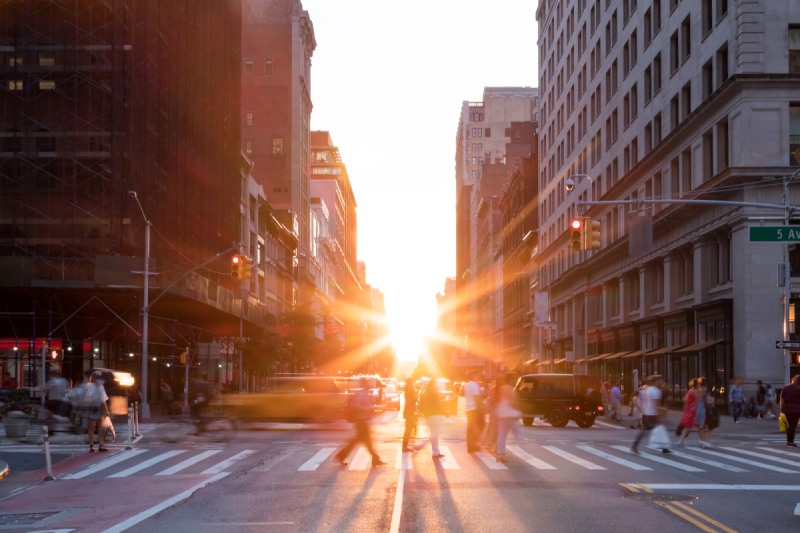
Twice every year, New Yorkers gather along Manhattan’s cross streets to witness the setting sun perfectly lining up with the city’s grid, creating one of the world’s most remarkable urban skywatching events: Manhattanhenge.
In 2026, Manhattanhenge will take place on May 28-29 and July 11-12. The best viewing spots are usually along 14th, 23rd, 34th, 42nd and 57th Streets while looking west toward New Jersey.
On May 28 and July 12, spectators will witness a “half sun” resting on the horizon, while May 29 and July 11 will deliver the more dramatic “full sun” effect.
The explanation comes down to Manhattan’s unique street layout and the shifting position of the setting sun throughout the year.
Let’s be honest. If you live in New York City, where light pollution ranks among the worst in the United States, there are not many celestial events to look forward to. Yet twice every year, people from across New York, around the country, and even around the globe gather in Manhattan to experience an unusual phenomenon that occurs close to sunset.
Around Memorial Day and again near July 12, New Yorkers become fascinated by a rare alignment that allows the setting sun to be visible simultaneously along many of Manhattan’s east-west streets, provided there is a clear view toward the New Jersey horizon. On these evenings, it’s common to see crowds gathered on street corners watching the sun align with Manhattan’s canyons of brick, glass and steel, creating dramatic scenes. In recent years, the term Manhattanhenge has become deeply rooted in pop culture, including serving as the title of a 2009 episode of the television series CSI: NY, as well as appearing in official clips for TV Land’s Younger (Season 3).
There are, of course, other places around the world where the sun aligns with landmarks at specific times of the year. The most famous example is Stonehenge, the Neolithic monument located in Wiltshire on England’s Salisbury Plain. On the summer solstice, observers standing inside Stonehenge can see the sun rise directly above the Heel Stone. The event attracts thousands of visitors annually.
Although researchers know the massive stones of Stonehenge took roughly 1,500 years to build and likely served as a burial site, many mysteries surrounding the monument remain unsolved. More than 50 years ago, British astronomer Gerald S. Hawkins and co-author John B. White released Stonehenge Decoded in 1965, claiming the structure was used to predict astronomical events. While the book gained widespread attention, many scientists rejected its conclusions. Decades later, debates about Stonehenge’s true purpose continue.
Unlike Stonehenge, the origins of Manhattanhenge are far less mysterious. The event is tied to Manhattan’s street design established in “The Commissioners’ Plan of 1811,” which introduced a rectilinear grid of streets and avenues intersecting at right angles. This design stretches from north of Houston Street to just below 155th Street in upper Manhattan. Most cross streets were arranged in a grid tilted 30 degrees east of true north to match the angle of Manhattan Island.
Because of this 30-degree tilt, the setting sun aligns with Manhattan’s streets not on the June solstice, but instead on specific dates in late May and early July.
Although people often say the sun sets in the west, that is not always technically true. Like the saying “a broken clock is correct twice a day,” the sun sets exactly due west only twice annually — during the March and September equinoxes. Between spring and autumn, the sunset point gradually shifts northward until the June solstice before moving south again afterward. On June 21, the sun sets at an azimuth of 302 degrees, or 32 degrees north of due west.
For Manhattanhenge to occur, however, the sun’s azimuth must reach 300 degrees, or 30 degrees north of due west. This happens twice each year — once in late May as the sun approaches the solstice, and again in early July as it moves back southward.
And that first opportunity in late May is approaching quickly.
The person credited with bringing widespread attention to Manhattanhenge nearly 30 years ago is astrophysicist and Hayden Planetarium director Dr. Neil deGrasse Tyson, who has written extensively about the phenomenon.
For visitors hoping to view or photograph this year’s event, Tyson recommends the wider “two-way” streets that provide the clearest view toward the west-northwest horizon over New Jersey, particularly 14th, 23rd, 34th, 42nd and 57th Streets.
“The Empire State Building and the Chrysler Building render (respectively) 34th street and 42nd streets especially striking vistas,” he notes.
Popular locations, especially 34th and 42nd Streets, often become crowded, so arriving at least 30 minutes before sunset is advised.
It’s also important to note that the listed times are not the exact sunset moments. Sunset officially refers to when the top edge of the sun disappears below a true astronomical horizon, such as over the ocean. For Manhattanhenge, adjustments must account for hills and structures on the distant New Jersey skyline, so the sun is considered about one degree above the actual horizon.
In 2026, there will be four viewing dates instead of two.
For the May event, mark May 28 and May 29 on your calendar. On May 28 at 8:14 p.m. EDT, viewers will see a “half sun,” with half the solar disk above the horizon and half below. On May 29 at 8:13 p.m. EDT, the “full sun” effect will appear, with the entire solar disk visible above the horizon.
If you miss the May dates, another opportunity arrives on July 11 and July 12. On July 11, the “full sun” effect will appear at 8:20 p.m. EDT, followed by the “half sun” effect on July 12 at 8:21 p.m. EDT.
Some may wonder whether Manhattanhenge can also be viewed at sunrise. The answer is yes, though observers must wait until late in the year or early the following year. Again, there are four opportunities surrounding the winter solstice on Dec. 22.
This time, viewers must look east toward an azimuth of 120 degrees, or 30 degrees south of due east. The first chance arrives on Dec. 9 with a “full sun” at 7:13 a.m. EST, followed by a “half sun” on Dec. 10 at 7:12 a.m. EST.
After the solstice, the sun shifts northward again. On Jan. 1, observers will see a “half sun” at 7:26 a.m. EST, followed by a “full sun” on Jan. 2 at 7:28 a.m. EST.
However, sunrise Manhattanhenge presents additional visibility challenges. Residents in Upper Manhattan and Harlem face obstructions from buildings in The Bronx, while viewers on the Upper East Side and Midtown look toward Queens, and those near the East Village and Houston Street face structures in Brooklyn.
In addition, late fall and winter mornings are often 30 to 60 degrees colder than summer evenings, and snow may even be present, particularly in January. Weather conditions for clear winter mornings are also less favorable compared to summer evenings.
Still, whether viewing Manhattanhenge during summer or winter, at sunrise or sunset, observers are encouraged to enjoy the spectacle and hope for clear skies.
Earlier this week, Meta announced that its widely used messaging platform, WhatsApp, will introduce usernames.… Read More
Volunteer firefighters are often the unsung heroes in many American towns, playing a pivotal role… Read More
You open your laptop after dinner, passport nearby, half a mug of tea going… Read More
Meta Platforms has announced that users can now reserve their preferred WhatsApp usernames, ahead of… Read More
Get ready to witness the first full moon of summer as the spectacular Strawberry Moon… Read More
The Championships at the All England Lawn Tennis and Croquet Club — widely recognized as… Read More
