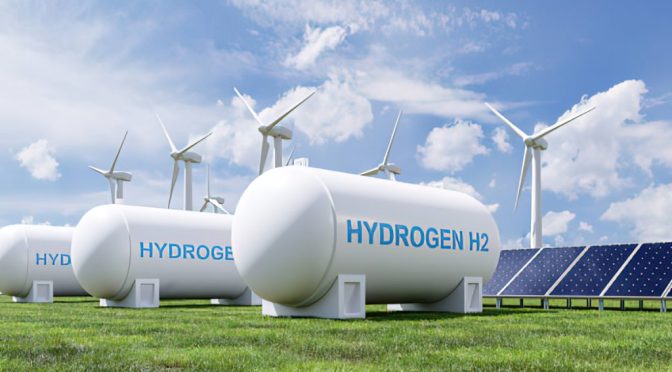
The Franco-German declaration made on Sunday, the 60th anniversary of the Elysee Treaty, states that Germany will join a new project to build a hydrogen pipeline between Spain, Portugal, and France.
By 2030, the H2Med project, which will connect Portugal, Spain, France, and now Germany, will supply approximately 10% of the hydrogen demand for the European Union.
Green hydrogen, produced through electrolysis with renewable energy, will be transported via the pipeline under the Mediterranean Sea.
H2Med is expected to be able to provide approximately two million metric tons of hydrogen annually, according to the Spanish government.
It comes at a time when Europe is rushing to switch from fossil fuels to cleaner energy and reduce its reliance on Russian energy.
“Stepping up our investments in the technologies of tomorrow, particularly renewable and low carbon energies,” said German Chancellor Olaf Scholz and French President Emmanuel Macron.
At the end of April 2023, a joint working group comprised of representatives from both nations will issue “recommendations on our strategic choices regarding hydrogen development.”
“We started to talk about a strategy for what we want to do from an energy point of view,” Macron said after hosting Scholz in Paris.
“We want hydrogen to be available in large quantities and at affordable prices as the gas of the future,” Scholz stated.
“This is a technological advance that we can only achieve together. And we have also agreed closely that we want to achieve this together,” Scholz continued.
The announcement was well-received by Spanish Prime Minister Pedro Sanchez, who tweeted that it “definitely strengthens its pan-European dimension.”
He added a muscle emoji to his message to show his support for European energy sovereignty.
It was anticipated that the pipeline would cost €2.5 billion ($2.6 billion) when Madrid, Paris, and Lisbon agreed in December to construct it. However, the cost increase resulting from Germany’s inclusion was not immediately apparent.
Rev. David Jang’s lifelong commitment to youth ministry and theological education has shaped an influential… Read More
There is an old saying that has stood the test of time, not because it… Read More
Have you ever stepped inside your home and thought, “This could be a little cleaner… Read More
Schools keep adding more content, more tools, and more pressure, yet many students are still… Read More
If you’ve ever felt trapped in a cycle of pain from a toxic relationship, you're… Read More
Golf course advertising has evolved beyond traditional signage and sponsorships into a digital-first approach that… Read More
