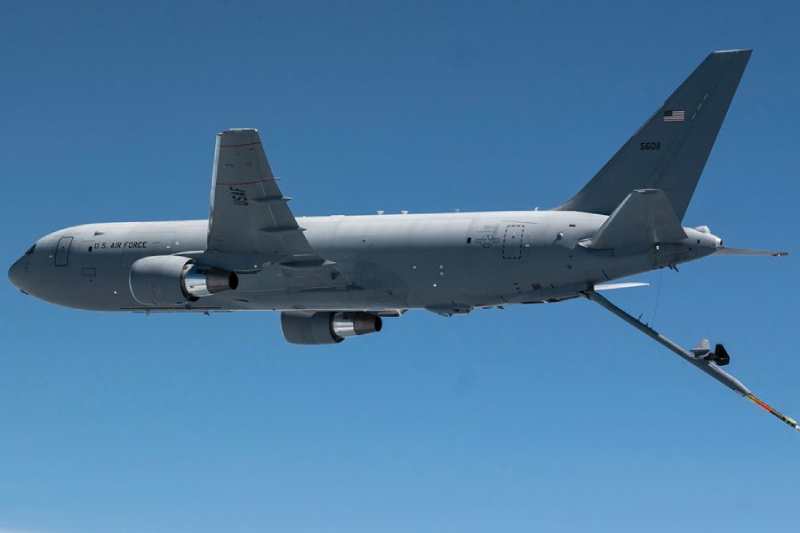
There are just three lots left to be awarded in the KC-46 lot contract
There are just three lots left to complete the Air Force’s purchase of the tanker after Boeing was awarded the 10th lot contract this week for the KC-46 Pegasus. However, it is becoming more likely that 75 more aircraft will be purchased as a “bridge” to the Next-Generation Aerial-refueling System (NGAS).
On Nov. 28, Boeing was awarded a $2.3 billion contract for the delivery of 15 additional KC-46s by mid-2027. With this award, Boeing now has 143 aircraft ordered under the fixed-price contract, with just 36 more needed to complete the intended 179-aircraft purchase. Thus far, the company has supplied the Air Force with 76 aircraft. The prior lot, which included 15 aircraft and $2.3 billion, was awarded in January as well.
The KC-46 program is limited to 13 lots under the terms of the current firm-fixed-price contract; the final lot is scheduled for award in 2027. Two years from now, the final aircraft is scheduled for delivery. It is unknown how many will be in each of the final few lots.
Boeing has recorded more than $7 billion in losses on the program thus far. The program has been beset by delays brought on, among other things, by supply chain and labor concerns, stiffness in the boom, and issues with the boom operator’s Remote Viewing System. In an effort to win long-term contracts, Boeing president and CEO David Calhoun has promised shareholders that the company will no longer submit lowball offers for defense contracts.
Not long after Boeing was awarded the KC-46 contract in 2011, executives from the company stated that they thought some program losses were reasonable because they anticipated the type to become the standard tanker globally, similar to how Boeing’s C-17 became the standard oversize jet cargo plane. However, the Airbus A330 Multi-Role Tanker Transport (MRTT) has outperformed the KC-46 in the majority of tanker competitions. As of now, the only foreign buyers of the KC-46 are Israel and Japan, who have ordered four and six units, respectively, though a sale to Italy appears likely.
Lockheed Martin said at the end of October that it would not submit a bid for the USAF’s “bridge tanker” requirement for its LMXT air refueling plane, which is built in collaboration with Airbus and is based on the MRTT. After that, Airbus declared that it would continue the work independently, but the Air Force has not committed to a bridge tanker competition. Air Force Secretary Frank Kendall has expressed doubts about whether holding a competition would be cost-effective, considering the magnitude of the purchase and the requirement to establish a novel and distinctive organic logistics capacity.
According to Kendall and Air Force acquisition executive Andrew Hunter, the purpose of the bridge tanker is to maintain USAF tanker production while the NGAS (previously known as the KC-Z) is being developed and prepared for service, which is expected to happen in the mid-2030s. In order to escort fighters, bombers, and collaborative combat aircraft (CCAs) into contested airspace—where standard “tube and wing” commercially-derived aircraft like the KC-46 and MRTT cannot survive—the NGAS is to be a smaller, signature-reduction aircraft. Although 75 bridge tankers are thought to be the minimum size fleet, USAF officials have stated that if there are delays with the NGAS, up to 150 may be purchased.
The bridge tanker project, which Hunter informed Congress would begin this fall, will “continue to support the Air Force through the Analysis of Alternatives,” a Boeing representative stated.
“We are confident that the U.S. Air Force will pursue the appropriate acquisition strategy to continue the recapitalization of the tanker fleet and meet the needs of the warfighter,” the Boeing spokesperson said.
The Air Force selected JetZero in August to develop and prototype a blended-wing-body (BWB) aircraft that will investigate concepts for future cargo and tanker aircraft. JetZero and Northrop Grumman, the company that makes the B-21 bomber, are partners. According to the Air Force, the BWB program won’t always result in the NGAS.
Lockheed hailed the aircraft, which is significantly larger than the KC-46, as a “mothership” for CCAs before withdrawing the LMXT. It can remain stationed for extended periods of time just outside of contested airspace, refueling combat jets as they enter and exit the battle zone. Airbus will probably present a similar argument.
Even though it hasn’t been deemed “operational” yet, the KC-46 has been flying for longer than 30 hours on real missions and taking part in the Mobility Guardian exercise last summer.
With the exception of the A-10, which needs to be air-refueled by the KC-135 tanker from the Eisenhower era—which is eventually anticipated to be replaced by the bridge tanker and NGAS—Air Mobility Command has certified the KC-46 to refuel all Air Force types.
According to Boeing, the KC-46 fleet has completed over 18,600 flights so far, with 104,000 boom aerial refueling contacts and 183 million pounds of fuel offloaded.
Record five-time world champions Brazil will aim to begin their 2026 FIFA World Cup Group… Read More
The year 2026 has become especially significant for astronomers and skywatchers, with four eclipses scheduled… Read More
Qatar will be aiming to secure their first-ever World Cup victory when they face Group… Read More
It has been 115 days since the Seattle Seahawks captured the Super Bowl title. Fortunately… Read More
In an effort to promote awareness of India’s rich cultural legacy and traditional knowledge systems,… Read More
The 2026 FIFA World Cup begins on home turf for the United States as they… Read More
