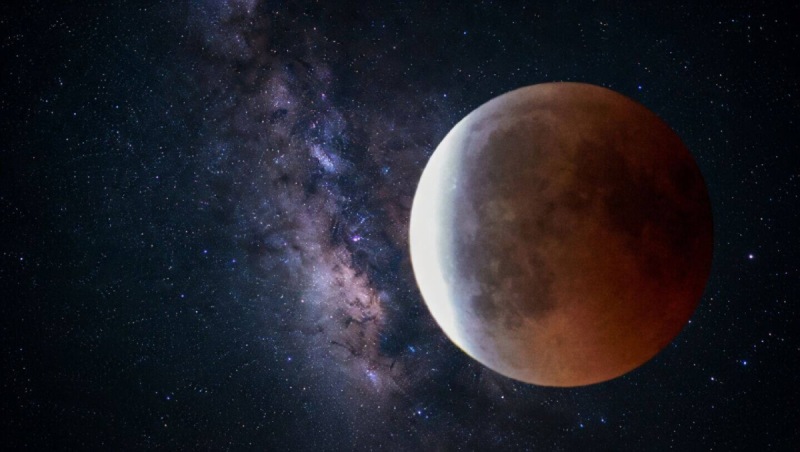
The year 2026 has become especially significant for astronomers and skywatchers, with four eclipses scheduled throughout the year. Two eclipses—one solar and one lunar—already took place in March, while two more are expected in August. The upcoming double eclipse event will include both a solar eclipse and a lunar eclipse. Here, we take a closer look at the year’s second and final lunar eclipse, which is set to be a striking celestial spectacle.
A partial lunar eclipse is expected to occur on Aug. 27-28. A lunar eclipse takes place when Earth, moving along its orbit, positions itself directly between the Sun and the Moon. As the Moon passes through Earth’s shadow during this alignment, its brightness diminishes. This uncommon astronomical event is known as a lunar eclipse.
A lunar eclipse always occurs during a full moon.
The lunar eclipse on the night of Aug. 27-28 will be observable across a substantial portion of the world. It will be visible from Africa, Europe, Scandinavia, Iceland, parts of Greenland, Antarctica, and much of North and South America.
Approximately 12% of the global population, or around 987 million people, will be able to witness every stage of the eclipse. Meanwhile, about 16% of the world’s population—roughly 1.3 billion people—will be able to observe the partial phase.
However, viewers in India will not be able to see the eclipse because the event will occur during daylight hours there.
Although the event is classified as a partial lunar eclipse, it will closely resemble a total lunar eclipse and may appear similar to a “Blood Moon.” However, it will not be an actual Blood Moon, as that phenomenon only occurs during a total lunar eclipse.
According to a report from Time and Date, as much as 96% of the Moon will pass into Earth’s shadow during the August event. The most favorable viewing conditions are expected across North and South America.
At the peak of the eclipse, the Moon is expected to take on a pale orange hue.
According to a report by Space.com, the entire eclipse will span 339 minutes from beginning to end. During the partial eclipse phase, the Moon will remain within Earth’s shadow for 119 minutes.
Another notable aspect of this event is that it will be the first deep partial lunar eclipse visible anywhere in the world since Sept. 18, 2014.
Why portfolio structure and the Gastauer Foundation matter after the June 2026 AUM revaluation The… Read More
A three-day trip can feel too short to need much preparation. You book the flight,… Read More
Apple is getting ready to roll out iOS 27 to supported iPhone models, bringing an… Read More
Crude oil and natural gas are among the most actively traded commodity derivatives in India.… Read More
Corporate health insurance can provide useful medical cover during employment, while a personal plan offers… Read More
Daily travel may feel routine, yet every commute involves changing traffic, busy roads, sudden braking… Read More
