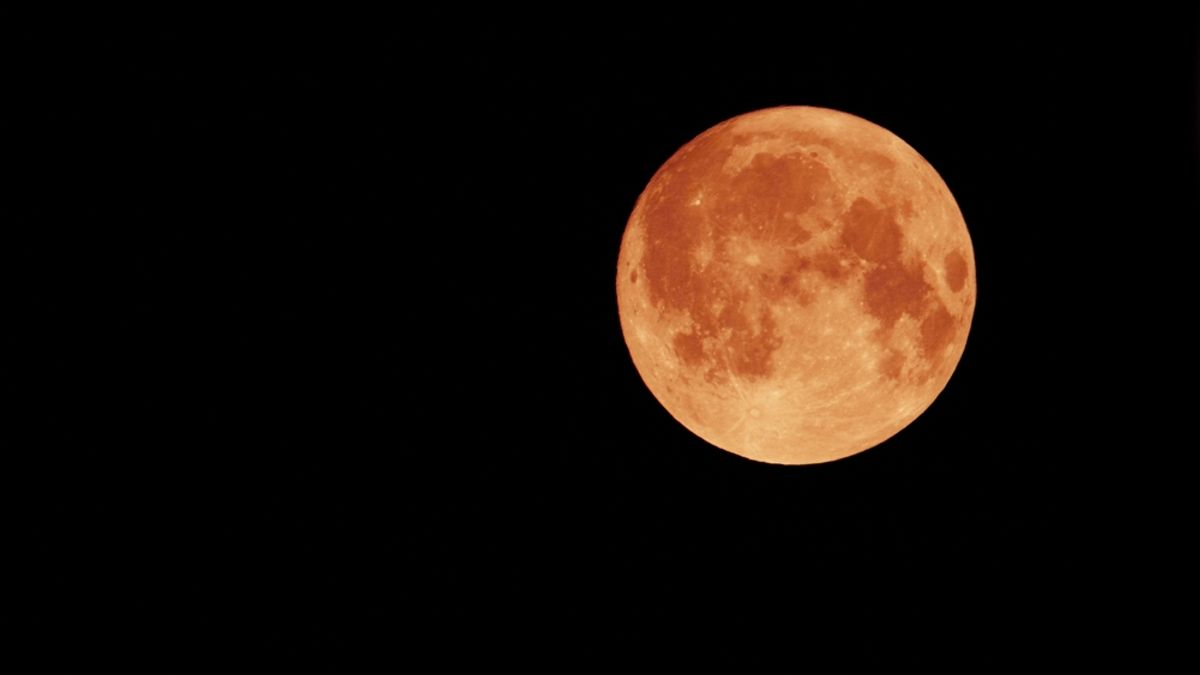
The August 2026 full moon will arrive at 12:18 a.m. (0416 GMT) on Aug. 28, when the lunar disk sits directly opposite the sun in Earth’s sky.
Its appearance will set the stage for a spectacular lunar eclipse toward the end of the month, with the event visible across the Americas as well as portions of Africa and Europe as Earth moves between the sun and moon, placing the lunar disk in shadow.
August’s full moon is commonly known as the Sturgeon moon — a Native American name connected to the period when giant fish are easiest to catch from the waters of the North American Great Lakes and Lake Champlain, according to the Old Farmer’s Almanac.
Observers across the U.S. will watch the Sturgeon Moon emerge above the eastern horizon at sunset on Aug. 27. During the hour after moonrise, the moon may take on a yellow-orange color because Earth’s atmosphere scatters the blue wavelengths in its light through a process called Rayleigh scattering.
The lunar disk can also seem slightly larger near the horizon because of an optical effect called the “Moon Illusion”. This visual trick causes our brains to perceive the moon as larger than its actual size when it appears near objects in the foreground, compared with its appearance higher overhead.
For viewers on the west coast of the U.S., including cities such as Los Angeles, Earth’s shadow will already be darkening the lunar surface when the moon rises. People watching from east coast cities such as New York, meanwhile, will need to wait several hours after sunset before our planet’s umbral outline begins moving across the lunar disk.
Viewers in Europe and Africa will witness the celestial alignment during the early morning hours of Aug. 28. At maximum eclipse, as much as 96% of the lunar disk will be covered by Earth’s inner shadow. The moon will take on a striking blood-red appearance as light passing through our atmosphere reaches its surface, while a narrow silvery crescent remains visible along its outer edge.
The table below provides local full moon times for when the moon reaches 100% illumination in a selection of cities around the world (local moonset and moonrise times will vary based on your location):
| City | Local time |
|---|---|
| New York | 00:18 a.m. EST on Aug. 28 |
| London | 5:18 a.m. BST on Aug. 28 |
| Beijing | 12:18 p.m. CST on Aug. 28 |
| Tokyo | 1:18 p.m. JST on Aug. 28 |
| Sydney | 2:18 p.m. AEDT on Aug. 28 |
The August full moon is frequently called the Sturgeon Moon, referring to the freshwater fish that are particularly easy to catch around the time of its appearance. North America’s indigenous Cree people also call it the Flying Up Moon, reflecting the season when young birds make their first flights.
Other indigenous communities refer to it as the Corn Moon, Harvest Moon and Ricing Moon, names associated with the period when different crops become ready for harvesting and collection. In England, it is also sometimes known as the Lightening moon, referring to the powerful storms that can occur during the latter part of summer, according to Time and Date.
The Aug. 28 full moon also falls on the Hindu celebration of Raksha Bandhan, which honors the relationship between brothers and sisters through gift exchanges, promises and the ritual tying of a symbolic silk string around brothers’ wrists by sisters, according to the City of Parramatta Research and Collections website.
The Sturgeon Moon will not be the night’s only attraction. Look upward from the lunar disk and you can spot the three brilliant stars that make up the Summer Triangle, whose light remains visible despite the brightness of the full moon.
The two lower stars are Altair and Deneb, representing the tails of the great eagle and swan in the constellations Aquila and Cygnus, respectively. Vega sits at the top of the celestial triangle within the constellation Lyra. Collectively, these stars provide an important reference point in the summer sky, helping both experienced observers and beginners navigate the broad field of stars.
Then look toward the west for Venus’s steady glow, positioned less than 10 degrees above the horizon — approximately the width of your clenched fist held at arm’s length against the sky. The sparkling point located to the moon’s upper left is the binary star system Alpha Virginis, also called Spica, the brightest star-like point in the constellation Virgo. The two objects will disappear below the horizon less than two hours after sunset, so seek an unobstructed western view to catch them before they set.
Saturn will emerge as a bright “evening star” to the lower left of the Sturgeon Moon several hours after sunset, while the four stars forming the Square of Pegasus asterism will appear overhead. The gas giant’s impressive rings are once again becoming more open to observers on Earth after its ring plane crossing in March last year, when the rings looked like little more than a narrow line crossing its banded cloud-covered disk.
Those who rise early will also have a captivating view during the predawn hours of Aug. 28. Jupiter will shine low in the eastern sky, with Mars’s red glow above it among the stars of the constellation Gemini. The recognizable stars of Orion will be visible nearby, providing an early glimpse of the constellations that dominate the sky during the lengthy winter nights.
The August full moon offers an unusual chance to witness the solar system’s orbital mechanics in action, with Earth’s shadow gradually moving over the lunar disk and revealing the movement of the solar system on a truly enormous scale.
| Month | Full moon name | Date and time |
|---|---|---|
| September | Corn Moon | 12:49 p.m. EDT (1649 GMT Sept. 26) |
| October | Hunter’s Moon | 11.12 p.m. EDT on Oct. 25 (0312 GMT) on Oct. 26 |
| November | Beaver Moon | 9:53 a.m. EDT (1453 BST) on Nov. 24 |
These times represent the precise moment when the moon reaches full illumination. Depending on where you are located, your local moonrise or moonset can occur several hours before or after these moments.
Diwali is not one mood. It is many. There's the quiet pooja in the morning.… Read More
Spotify revealed on Wednesday that it is broadening audiobook availability to more than 180 markets… Read More
A family business proves its relevance each time a new generation finds something worthwhile to… Read More
Sometimes, the biggest opportunities begin when you realize you have outgrown where you are. For… Read More
Apple started introducing Apple Pay in India on Tuesday. Axis Bank, the country's third-largest private-sector… Read More
As all-in-one AI agents such as Meta’s Muse and Instinct gain momentum, Google has announced… Read More
