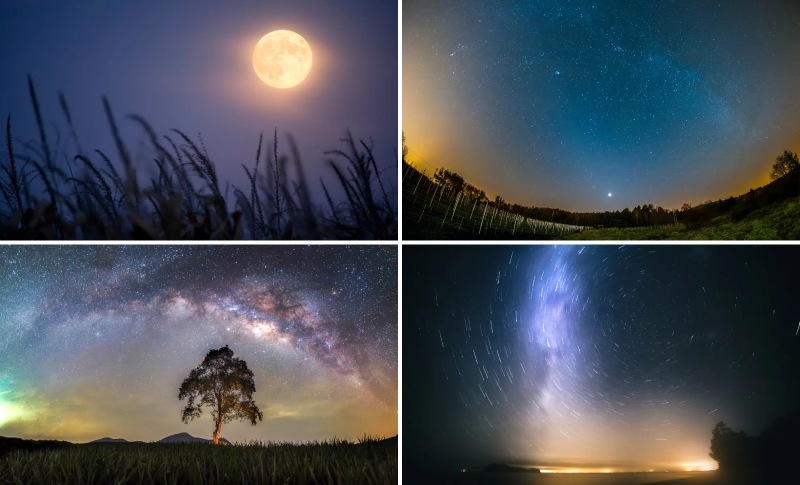
September is offering skywatchers several opportunities to observe notable events. Venus will reach its greatest brilliance, the Autumn Equinox will signal the seasonal transition, and the Harvest Moon will appear near Saturn and Neptune later in the month.
A recent BBC Weather Instagram post drew attention to several celestial events taking place in September, urging people to spend some time observing the changing night sky. NASA’s September skywatching guide likewise identifies Venus, the equinox and the Harvest Moon among the month’s notable highlights.
For people who follow astrology, these astronomical events may carry an additional symbolic significance. Astrology often assigns meaning to the movements of planets and the Moon, connecting them with subjects such as relationships, personal development, balance and fresh starts. These symbolic interpretations differ from the observations and explanations provided by astronomy.
Here are the events US skywatchers can observe before September comes to an end.
Venus is among the easiest planets to identify in the sky because of its exceptional brightness. NASA says the planet reaches peak brilliance for its current evening appearance on September 18. Look toward the western sky soon after sunset, preferably from a location with an unobstructed view near the horizon.
Earlier in September, Venus also appeared close to the crescent Moon. The two objects were visible near one another after sunset on September 14, making the pairing one of the month’s more prominent observing opportunities.
In astrology, Venus is traditionally connected with love, partnerships, pleasure, beauty and personal values. Venus moved into Scorpio on September 10, a transition that astrologers commonly associate with greater emphasis on emotional intensity, intimacy and openness within relationships.
For those who follow astrology, the prominent evening appearance of Venus can consequently serve as an opportunity to think about personal values and the relationships in which they seek greater depth.
The September Equinox takes place on September 22, 2026, signaling the start of astronomical autumn in the Northern Hemisphere. Around the equinox, NASA explains, the Sun is positioned directly above Earth’s equator, resulting in day and night being approximately equal in length across the globe.
The equinox also carries significance within astrology because the Sun enters Libra, which begins Libra season in the tropical zodiac. Libra is traditionally linked with balance, partnerships, cooperation and fairness.
As a result, the equinox can provide a natural occasion for personal reflection.
The Full Moon on September 26 is known as the Harvest Moon in the Northern Hemisphere because it is the full Moon occurring closest to the autumnal equinox. It will appear around sunset and should remain in the sky for much of the night.
According to tropical astrology calendars, September’s Full Moon takes place in Aries. It is positioned opposite the Sun in Libra, creating the traditional Aries-Libra association between independence and relationships.
For astrology followers, the Full Moon may therefore provide a point to reflect on situations where prioritizing personal needs matters and where compromise may be necessary.
The Harvest Moon will share the sky with other planets. On September 26, Saturn will appear close to the Moon, while the much dimmer Neptune will also be nearby. NASA notes that Saturn is visible without optical equipment, but Neptune is too faint to see with the unaided eye and requires binoculars or a telescope.
That combination makes September 26 an appealing evening for casual observers as well as those equipped with binoculars or a telescope.
Astrology does not necessarily view every astronomical occurrence as a prediction. Instead, many practitioners regard planetary movements, transits and lunar phases as symbolic opportunities for personal reflection.
The September combination of Virgo season, the Libra equinox, Venus in Scorpio and the Aries Full Moon provides a progression from organisation and inward reflection toward relationships, equilibrium and personal direction.
Earlier in the month, the Virgo New Moon can be interpreted astrologically as an opportunity to establish practical intentions. The equinox subsequently moves attention toward Libra subjects involving balance and partnership, while the Aries Full Moon redirects the focus toward the individual.
Most of September’s major skywatching events do not require costly equipment. With favorable viewing conditions, Venus, the Moon and Saturn are all visible without a telescope.
Choosing a dark area away from significant urban lighting can improve visibility.
Before going outside, check the local weather conditions and allow your eyes some time to adapt to the darkness. To watch the Harvest Moon, face the eastern horizon around sunset on September 26.
SIU Swiss International University, a member of the VBNN Smart Education Group, has officially opened… Read More
Why portfolio structure and the Gastauer Foundation matter after the June 2026 AUM revaluation The… Read More
Apple officially revealed its next-generation products tonight, introducing some of the most significant changes in… Read More
Apple has officially introduced the release candidate (RC) build of macOS 27, known internally as… Read More
Siri AI, Apple's long-awaited overhaul of its digital assistant, will become available in five additional… Read More
A three-day trip can feel too short to need much preparation. You book the flight,… Read More
