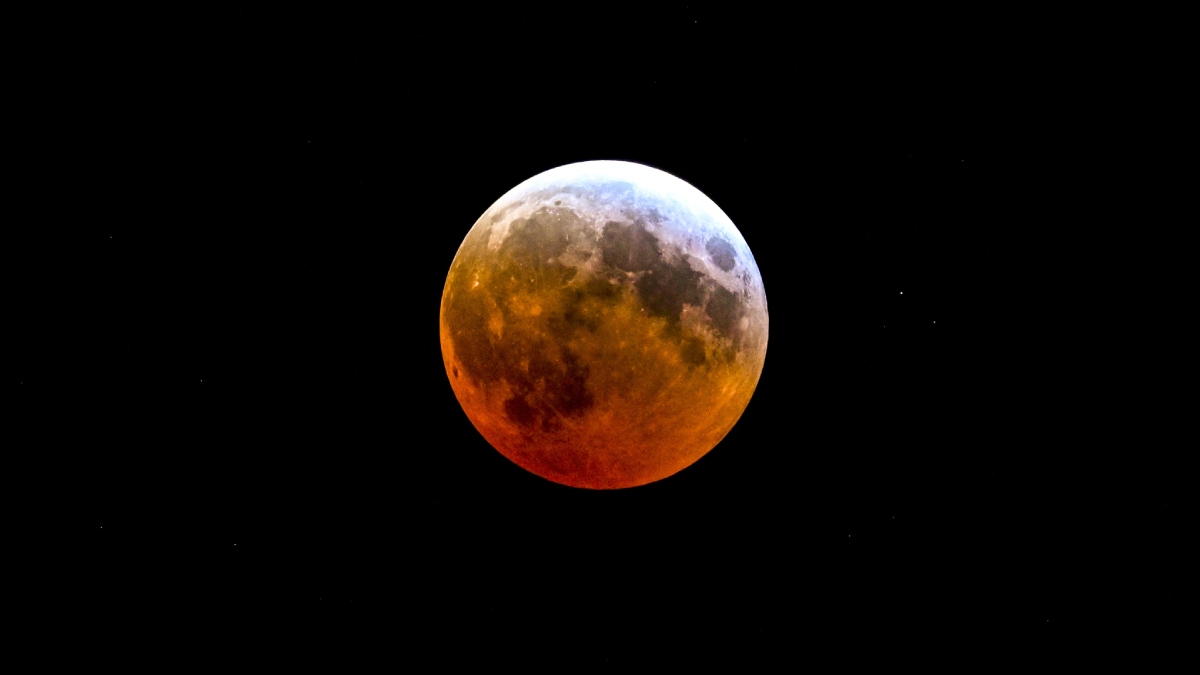
August has been packed with celestial activity. Following the recent solar eclipse and the Perseids meteor shower, a partial lunar eclipse will now make an appearance in the night sky.
Skywatchers across much of North America will have an opportunity this week to observe Earth’s shadow gradually moving across the surface of the full moon. Interested in learning more? Read on to find out when to watch and what you should know about the event.
According to Time and Date, the partial lunar eclipse will occur on Aug. 27–28, 2026. It will begin during the evening of Aug. 27 before reaching its peak in the early morning hours of Aug. 28. The exact timing will depend on where you are located, but NASA estimates the peak to occur at around 12:13 a.m. ET.
NASA explains that a lunar eclipse occurs when Earth passes between the Sun and the Moon, resulting in the Moon moving through Earth’s shadow. A lunar eclipse can occur only during a full moon, when the three celestial bodies are positioned closely enough for Earth’s shadow to cross the Moon’s surface.
This particular event is only a partial eclipse. During a partial lunar eclipse, just part of the Moon travels through Earth’s shadow. From our perspective on Earth, the portion covered by the shadow can look significantly darker compared with the illuminated section of the Moon. The precise appearance of the eclipse depends on how the Sun, Earth, and Moon are positioned relative to one another.
A total lunar eclipse takes place when the Sun, Earth, and Moon become aligned, placing Earth directly between the other two bodies. Although the Moon continues to receive a small quantity of sunlight, that light must first pass through Earth’s atmosphere. The atmosphere scatters much of the blue light, allowing a greater amount of red and orange light to reach the Moon, giving it a reddish appearance.
Fortunately, unlike a solar eclipse, observing a lunar eclipse with the naked eye is entirely safe, meaning you do not require special glasses or other equipment.
The easiest way to watch it is simply to find a location with an unobstructed view of the sky and minimal light pollution. Face the Moon as the eclipse begins, and you will be able to watch Earth’s shadow slowly move across a section of its surface.
Binoculars or a telescope can provide a more detailed view, but neither is required if you do not have access to one.
A family business proves its relevance each time a new generation finds something worthwhile to… Read More
Sometimes, the biggest opportunities begin when you realize you have outgrown where you are. For… Read More
Apple started introducing Apple Pay in India on Tuesday. Axis Bank, the country's third-largest private-sector… Read More
As all-in-one AI agents such as Meta’s Muse and Instinct gain momentum, Google has announced… Read More
Major League Baseball's 2026 postseason begins Tuesday, Sept. 29 with four best-of-three wild card series,… Read More
A Career Built on Authentic Beauty For more than 30 years, Brigitta Würfl has built… Read More
