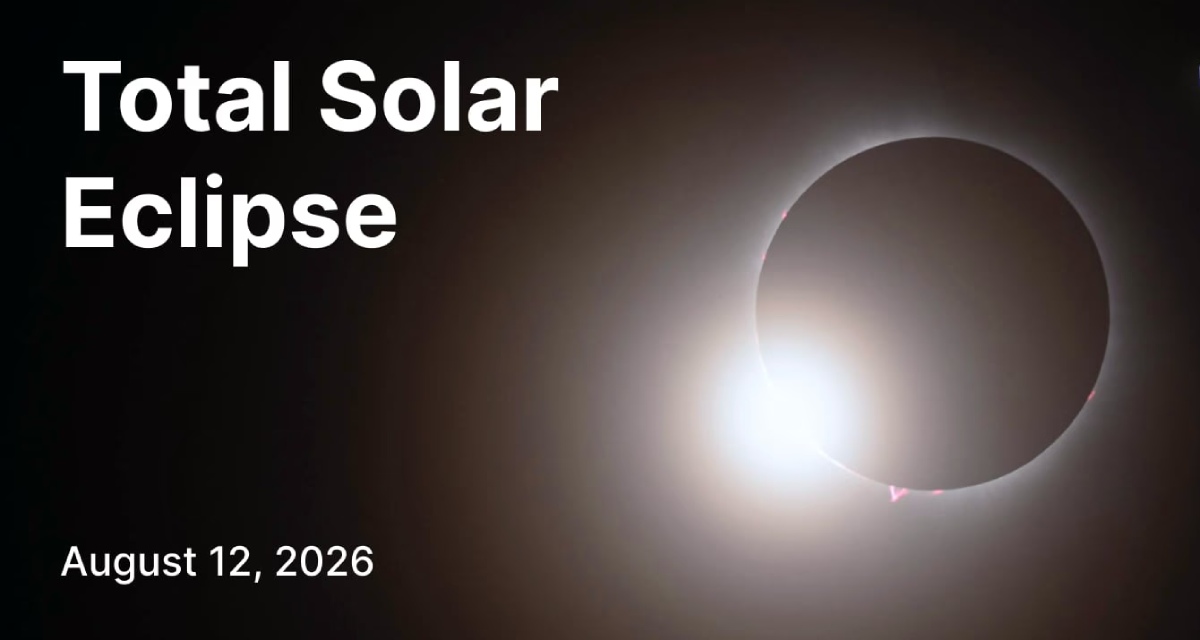
The next total solar eclipse is when? It’s time to start preparing for mainland Europe’s first total solar eclipse since 1999 if you missed April 8, 2024, or if it left you wanting more. The Moon will pass directly in front of the sun on Wednesday, August 12, 2026, creating shadows across parts of Greenland, Iceland, and Spain. One of nature’s most amazing sights will unfold over a variety of breathtaking locations for a few minutes when the day turns to dusk and the sun’s corona appears. This is all the information you need to organize the best eclipse trip.
Only a very small path of totality is visible during a total solar eclipse. The Moon’s shadow will travel from the Arctic to the Mediterranean Sea on August 12, 2026, covering a distance of around 5,133 miles (8,260 km) in length and up to 182 miles (293 km) in width.
It starts in northern Siberia, Russia, passes through eastern Greenland, crosses western Iceland, enters northern Spain, and ends just east of the Balearic Islands. Only a partial eclipse will occur anywhere outside of that path, even if it is only a few miles away.
Where you are determines the precise time. In Greenland, totality occurs in the afternoon when the sun is comparatively high in the sky.
In Spain, it turns into an early evening event that starts just before sunset, but in Iceland, it happens in the late afternoon.
Totality will be short no matter where you are watching. Although practically all eclipse chasers on land will see slightly less, the maximum length is 2 minutes 18 seconds. You won’t quite achieve the maximum unless you’re on a well-positioned cruise ship because the longest time happens over the ocean close to Iceland.
This eclipse is different from the one that will traverse North America in 2024 in that the sun will be comparatively low in the sky.
In Spain, it can be only a few degrees above the western horizon, and nowhere along the route does it climb over approximately 26 degrees above the horizon. This raises the possibility of occlusion while also producing breathtaking visual possibilities, such as a “sunset eclipse” with the corona blazing over far-off landscapes. The view may be obscured by buildings, hills, clouds, or even far-off haze. In Spain, picking a spot with a clear western horizon is essential, even though the weather forecast will be important on the day.
Every area along the route offers a unique experience, and totality is expected to take place in some very different experience.
Weather for the Total Solar Eclipse 2026
Welcome to the eclipse-chasing dilemma: better weather versus better geometry. In August, clear skies are more likely to occur in inland Spain, especially in areas like Castilla y León. Islands and coastal regions may also have good chances, although even thin cloud layers close to the horizon could block the eclipse due to the extremely low sun angle. In contrast, if the skies are clear, Iceland and Greenland provide higher sun positions during totality, making viewing easier; but, cloud cover is less predictable.
What occurs after the eclipsed sun sets is what makes the eclipse in 2026 particularly fascinating. In actuality, it is extremely uncommon for so many astronomical events to coincide with a total solar eclipse.
One of the most active meteor showers of the year, the Perseid, peaks at the same time as the eclipse. The Milky Way stretches throughout the sky, and dozens of meteors can be seen per hour under dark skies. That’s a reason for visiting Spain.
The shorter and lighter nights in Greenland and Iceland virtually eliminate all but the brightest “shooting stars.” There is still a slight possibility of witnessing the aurora borealis, though.
The possibility of seeing the northern lights will significantly rise if you spend several nights in these areas, especially in the weeks after the eclipse.
As an added benefit for all locations, on August 12, Venus will become 50% illuminated and enter its crescent phase as it approaches Earth, making it an excellent target for a small telescope.
Early planning is important. Since August is the busiest tourism month in Europe, there will be a lot of demand for accommodation along the line of totality. To investigate places and keep an eye on weather forecasts, arrive at least a few days ahead of time.
Roads in Iceland and Spain will be clogged in the hours leading up to and following the eclipse, but you don’t have to avoid traveling on the day of the eclipse because it occurs later in the day.
Above everything, maintain flexibility. Experienced eclipse chasers are ready to relocate if circumstances change and always have backup places.
Record five-time world champions Brazil will aim to begin their 2026 FIFA World Cup Group… Read More
The year 2026 has become especially significant for astronomers and skywatchers, with four eclipses scheduled… Read More
Qatar will be aiming to secure their first-ever World Cup victory when they face Group… Read More
It has been 115 days since the Seattle Seahawks captured the Super Bowl title. Fortunately… Read More
In an effort to promote awareness of India’s rich cultural legacy and traditional knowledge systems,… Read More
The 2026 FIFA World Cup begins on home turf for the United States as they… Read More
