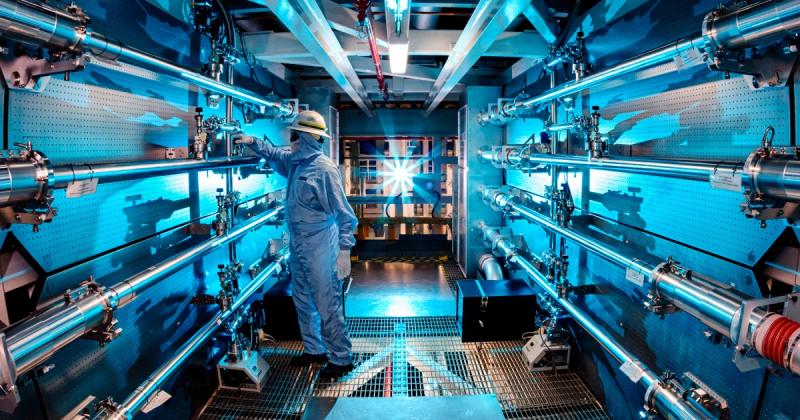
The search for a nearly infinite, secure, and healthy energy source by US scientists has yielded a net energy gain in a nuclear fusion reaction for the second time since a historic breakthrough in December of last year.
The achievement was replicated by researchers at the Lawrence Livermore National Laboratory in California on July 30 in an experiment at the National Ignition Facility (NIF) that resulted in a higher energy yield than in December, according to a Lawrence Livermore spokesperson.
The representative stated that the final data are still being analyzed.
In nuclear fusion, light elements like hydrogen are fused together to create heavier elements, which results in a massive release of energy. The process, which creates the heat and light of the sun and other stars, has been praised for its enormous potential as a clean, renewable energy source.
In a fusion experiment employing lasers, Lawrence Livermore became the first to record a net energy gain in December. According to the Energy Department, that experiment temporarily accomplished fusion ignition by producing 3.15 megajoules of energy after the laser delivered 2.05 megajoules to the target.
In other words, according to the department, it generated more fusion energy than it did laser energy.
It was dubbed “a major scientific breakthrough decades in the making that will pave the way for advancements in national defense and the future of clean power” by the US Department of Energy.
Fusion energy has the potential for an abundant supply of clean energy because the processes don’t produce any radioactive waste or greenhouse gases as byproducts. Deuterium and tritium, the heavier types of hydrogen that makeup fusion fuel, can produce as much energy per kilogram as 10 million kilograms of fossil fuel. But getting here required 70 years of effort.
Scientists have praised the most recent developments as proof that the power of the stars may be harnessed on Earth, but warning that the technology is far from being ready to transform into commercial power plants and is not likely to solve the climate catastrophe.
After missing out on AFCON 2025, Ghana will be eager to respond on football’s grandest… Read More
England and Croatia face off at Dallas Stadium in Arlington in their opening group-stage fixture… Read More
Cristiano Ronaldo’s Portugal get their 2026 World Cup campaign underway against DR Congo in Houston… Read More
Adobe has introduced updates to five Creative Cloud applications in a single release. Lightroom’s Assisted… Read More
Amazen King Roe, a Nigerian-American, Pennsylvania-borne, California renaissance man, who has built an impressive career… Read More
Belgium kick off their FIFA World Cup campaign in their opening Group G encounter on… Read More
