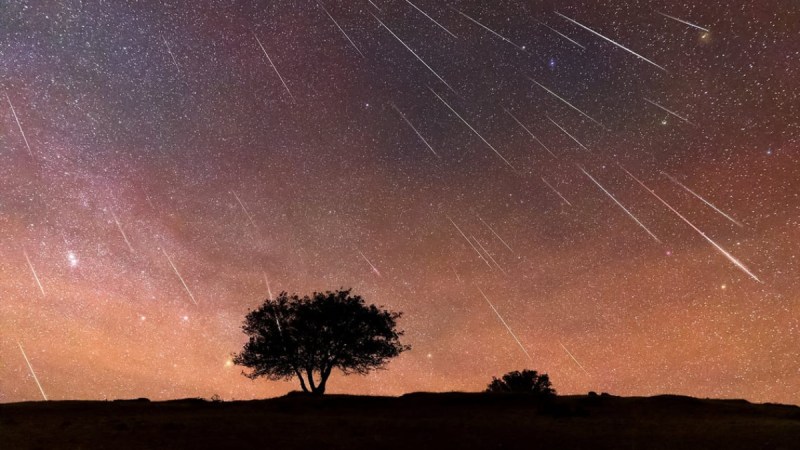
On August 12–13, the Perseid meteor shower peaks, bringing with it the possibility of seeing a stunning fireball and an explosion of shooting stars.
One of the year’s most eagerly awaited shooting star displays is the Perseids. The glare from the waning gibbous moon, which coincides with the 2025 shower, will make it difficult to see anything but the brightest meteors.
Nevertheless, given that the Perseids are known to produce spectacular fireballs, it is worthwhile to travel to a dark sky spot for a meteor hunt! Though many will be obscured this year by the brightness of the 86%-lit waning gibbous moon, the optimum time to see Perseids is during the predawn hours of August 13, when up to 100 shooting stars per hour would be visible under ideal circumstances.
“The best rates will probably be near 15 per hour as dim meteors make up a majority of the activity,” meteor expert Robert Lunsford from the American Meteor Society, told Space.com in an email. You may also catch meteors as early as 10 p.m. local time, according to NASA.
“You can watch for long Perseid earthgrazers as soon as it gets dark until the moon begins to interfere. This will be about an hour for most folks,” Lunsford continued.
Though the rates will be low at this time, any meteors spotted will be long and impressive, Lunsford explained.
Read More: Things to Know about the Perseid Meteor Shower, Summer ‘Shooting Star’ Season 2025
By observing the trajectory of a meteor as it blazes through the night sky, you can distinguish Perseids from shooting stars of various origins.
Lunsford also suggests looking north with the moon behind you and searching for Perseids at between 1 and 5 a.m. local time. According to Lunsford, “this is when you will see up to 15 per hour,”
In the constellation Perseus, which is located in the northeastern sky with the moon and Saturn off to its right on the night of August 12, meteors linked to the August shower can always be seen streaking away from a point of origin — or ‘radiant’ — near the magnitude 3.89 star Eta Persei.
Simply use an astronomy app on your smartphone to determine the radiant and then choose a point around 40 degrees above it to discover the best meteor hunting patch of sky. The longest meteor tracks will be found here. Keep in mind that the distance between your clinched fist and the night sky at arm’s length is about 10 degrees.
Every year, as Earth moves through the debris trail left by comet 109P/Swift-Tuttle, the Perseid meteor shower takes place. When small comet shards contact our atmosphere at up to 37 miles per second (59 kilometers per second), they leave a flaming, if brief, path in the Earth’s sky, which is known as a shooting star.
“The peak is the best time to view regardless of the situation with moonlight,” said Lunsford. “Rates fall by 50% each night after the peak, so by the time the moon is out of the way, there is little left to watch.”
Diwali is not one mood. It is many. There's the quiet pooja in the morning.… Read More
Spotify revealed on Wednesday that it is broadening audiobook availability to more than 180 markets… Read More
A family business proves its relevance each time a new generation finds something worthwhile to… Read More
Sometimes, the biggest opportunities begin when you realize you have outgrown where you are. For… Read More
Apple started introducing Apple Pay in India on Tuesday. Axis Bank, the country's third-largest private-sector… Read More
As all-in-one AI agents such as Meta’s Muse and Instinct gain momentum, Google has announced… Read More
