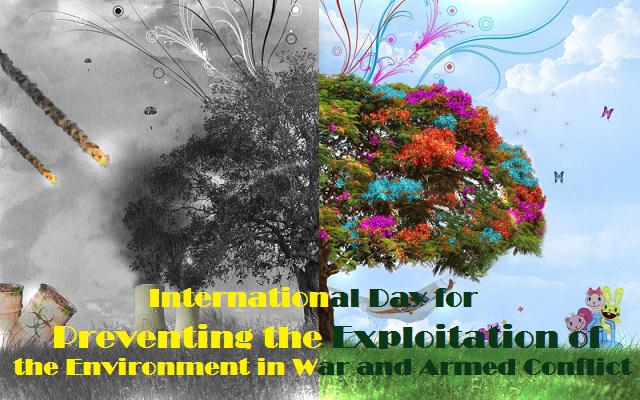
International Day for Preventing the Exploitation of the Environment in War and Armed Conflict is celebrated every year on November 6 across the world to raise awareness about the environmental damage caused because of wars during armed encounters.
The environment has regularly stayed a quiet victim of wars and armed clashes, as war casualties are normally included regarding the dead or injured or the destruction caused to livelihoods and urban areas.
The death toll and the destruction of property are clear outcomes of war and armed conflict. Be that as it may, the most widely recognized target during the conflicts has been the environment. There is another outcome also. This is the negative impact that war and conflict have on the environment. Some of these negative impacts include:
Sometimes these things are even done deliberately to increase a military advantage. There are likewise conflicts that include natural resources, for example, oil, gold, diamonds, and timber. As per the United Nations Environmental Programme (UNEP), 40% of internal conflicts have been connected to the exploitation of natural resources in the last 60 years.
War and armed conflict have many harming consequences for the natural environment. For instance, crops are devastated, water supplies are poisoned and forests are burnt. A new technology that is used for war implies that the destruction and harm of the environment are more serious and the long-term outcomes can be more terrible.
On 5 November 2001, the UN General Assembly announced 6 November of every year as the International Day for Preventing the Exploitation of the Environment in War and Armed Conflict (A/RES/56/4).
The day is observed annually across the world to spread awareness concerning the equivalent and guarantee the protection of the environment and ecosystem under any situation.
The World Day for preventing environmental exploitation during the war and armed conflict was set up by the United Nations General Assembly on November 5, 2001, during Kofi Annan’s term as UN Secretary-General.
The UN Environment Assembly received a resolution in May 2016, which featured the huge role of healthy ecosystems and sustainable resources in diminishing the chances of armed conflict. In the event, the UN body likewise reaffirmed its strong commitment to the full implementation of the Sustainable Development Goals.
The assembly likewise reviewed the United Nations Millennium Declaration, which underlined the need of working to protect the environment.
On 27 May 2016, the United Nations Environment Assembly adopted resolution UNEP/EA.2/Res.15, which perceived the role of healthy ecosystems and sustainably managed resources in decreasing the danger of armed conflict, and reaffirmed its strong commitment to the full implementation of the Sustainable Development Goals recorded in General Assembly resolution 70/1, named “Transforming our world: the 2030 Agenda for Sustainable Development”.
The United Nations Environment Program uncovered that in the last 60 years, very nearly 40% of the internal conflicts were connected with the exploitation of scant and high-value natural resources, for example, fertile land, water, timber, jewel, gold, and oil. The UN programme found that contentions over natural resources were twice bound to backslide in contrast with different conflicts.
Albeit a few protection measures have been taken by the governments and a few legal instruments, the environment is as yet influenced by the armed conflicts around the world. The day expects to guarantee that the environment isn’t destroyed during incidents of armed encounters.
At the time of war, it influences the ecosystem. The environment is influenced as the forests have been chopped down, water wells contaminated, crops burned, soil poisoned, and creatures killed, and so forth. Even though humanity has consistently included its war casualties regarding the dead and injured warriors and civilians, obliterated urban communities and livelihoods, the environment has frequently remained the unpublicized victim of war. Water wells have been contaminated, crops burnt, forests cut down, soils poisoned, and animals killed to increase the military advantage.
As indicated by the UN, guaranteeing the protection of the environment is a part of conflict prevention, peacekeeping, and peace-building methodologies, as there can be no durable harmony if the natural resources that help and sustain livelihoods and ecosystems are annihilated.
On the day discussions about how the impacts of war are harming the natural environment happen. Individuals additionally cooperate to discover approaches to restrict environmental destruction caused by armed conflict and war.
Speeches, lectures, media coverage, and related study activities in schools are some of the events that occur on this day.
As all-in-one AI agents such as Meta’s Muse and Instinct gain momentum, Google has announced… Read More
Major League Baseball's 2026 postseason begins Tuesday, Sept. 29 with four best-of-three wild card series,… Read More
A Career Built on Authentic Beauty For more than 30 years, Brigitta Würfl has built… Read More
While the release of iOS 27 took much of the attention, Apple also rolled out… Read More
Adjusting your AirPods settings can make a noticeable difference to your listening experience by providing… Read More
How separate investment and philanthropic mandates can support research project readiness and durable conservation outcomes… Read More
