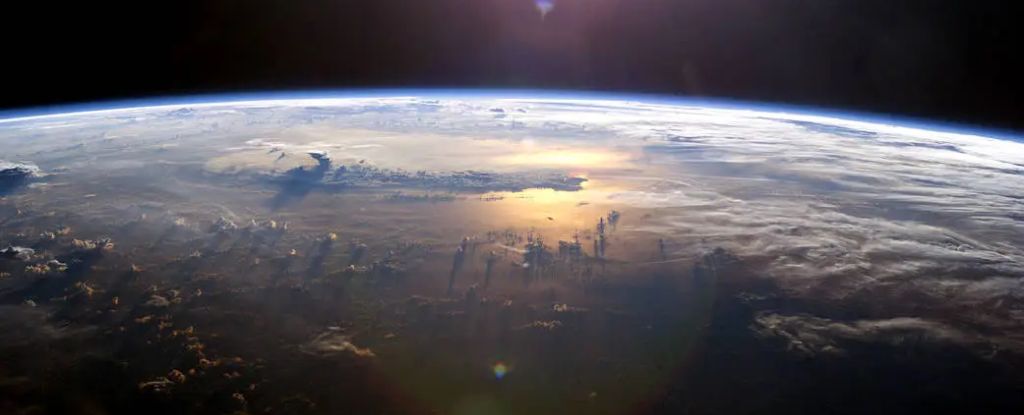
Finally, a weak, invisible energy field that encircles planet Earth has been detected and measured.
The discovery of the electric field known as the ambipolar field, which was first hypothesized more than 60 years ago, will change our understanding of the behavior and evolution of our beautiful, ever-changing world.
“Any planet with an atmosphere should have an ambipolar field,” says astronomer Glyn Collinson of NASA’s Goddard Space Flight Center.
“Now that we’ve finally measured it, we can begin learning how it’s shaped our planet as well as others over time.”
Earth is more than just a blob of dirt sitting inert in space. Fields of every kind surround it. There’s the gravity field. Even though gravity is present everywhere, we do not know much about it, but we would not have a planet. Additionally, gravity aids in securing the atmosphere to the surface.
Additionally, there is the magnetic field, which is created when the Earth’s interior’s rotating, conducting material transforms kinetic energy into a magnetic field that radiates into space. This helps to keep the atmosphere from blowing away and protects our planet from the effects of solar wind and radiation.
A phenomenon that we wouldn’t have noticed until the space age was described by scientists in 1968. A supersonic wind of particles escaping from Earth’s atmosphere was observed by spacecraft passing over the poles of the planet. A third, the electric energy field, offered the most convincing explanation for this.
“It’s called the ambipolar field and it’s an agent of chaos. It counters gravity, and it strips particles off into space,” Collinson explains in a video.
“But we’ve never been able to measure this before because we haven’t had the technology. So, we built the Endurance rocket ship to go looking for this great invisible force.”
This is the way the ambipolar field was supposed to work. Extreme ultraviolet and solar radiation ionize atmospheric atoms at an altitude of about 250 kilometers (155 miles), breaking off negatively charged electrons and transforming the atom into a positively charged ion in a layer of the atmosphere known as the ionosphere.
The lighter electrons will attempt to take off into space, while the heavier particles will attempt to sink towards the ground. However, the plasma environment will attempt to maintain charge neutrality, causing an electric field to form between the ions and electrons to bind them together.
This is known as the ambipolar field since it works in two directions, with the ions supplying a downward pull and the electrons an upward one.
The atmosphere becomes inflated as a result; The polar wind is the result of some ions escaping into space as a result of the increased altitude.
Collinson and his team designed instruments to detect this ambipolar field because it would be so weak. The Endurance mission, carrying this experiment, was launched in May 2022, reaching an altitude of 768.03 kilometers (477.23 miles) before falling back to Earth with its valuable, hard-won information.
Furthermore, it succeeded. It only measured a 0.55-volt change in electric potential, but that was all that was needed.
“A half a volt is almost nothing – it’s only about as strong as a watch battery,” Collinson says. “But that’s just the right amount to explain the polar wind.”
That amount of charge is sufficient to pull on hydrogen ions with 10.6 times the strength of gravity, launching them into space at the supersonic speeds estimated over Earth’s poles.
The ionosphere’s density at high altitudes is increased by 271% compared to its density without the ambipolar field because oxygen ions, which are heavier than hydrogen ions, are lofted higher.
Even more exciting is the fact that this is only the beginning. We don’t know much about the ambipolar field’s wider implications, including how long it has existed, what it does, and how it has influenced the evolution of our planet, its atmosphere, and possibly even the life that lives there.
“This field is a fundamental part of the way Earth works,” Collinson says. “And now we’ve finally measured it, we can actually start to ask some of these bigger and exciting questions.”
A roof rarely fails all at once. It starts with a few lifted shingles after a windy… Read More
Spotify revealed on Wednesday that it is broadening audiobook availability to more than 180 markets… Read More
A family business proves its relevance each time a new generation finds something worthwhile to… Read More
Sometimes, the biggest opportunities begin when you realize you have outgrown where you are. For… Read More
Apple started introducing Apple Pay in India on Tuesday. Axis Bank, the country's third-largest private-sector… Read More
As all-in-one AI agents such as Meta’s Muse and Instinct gain momentum, Google has announced… Read More
