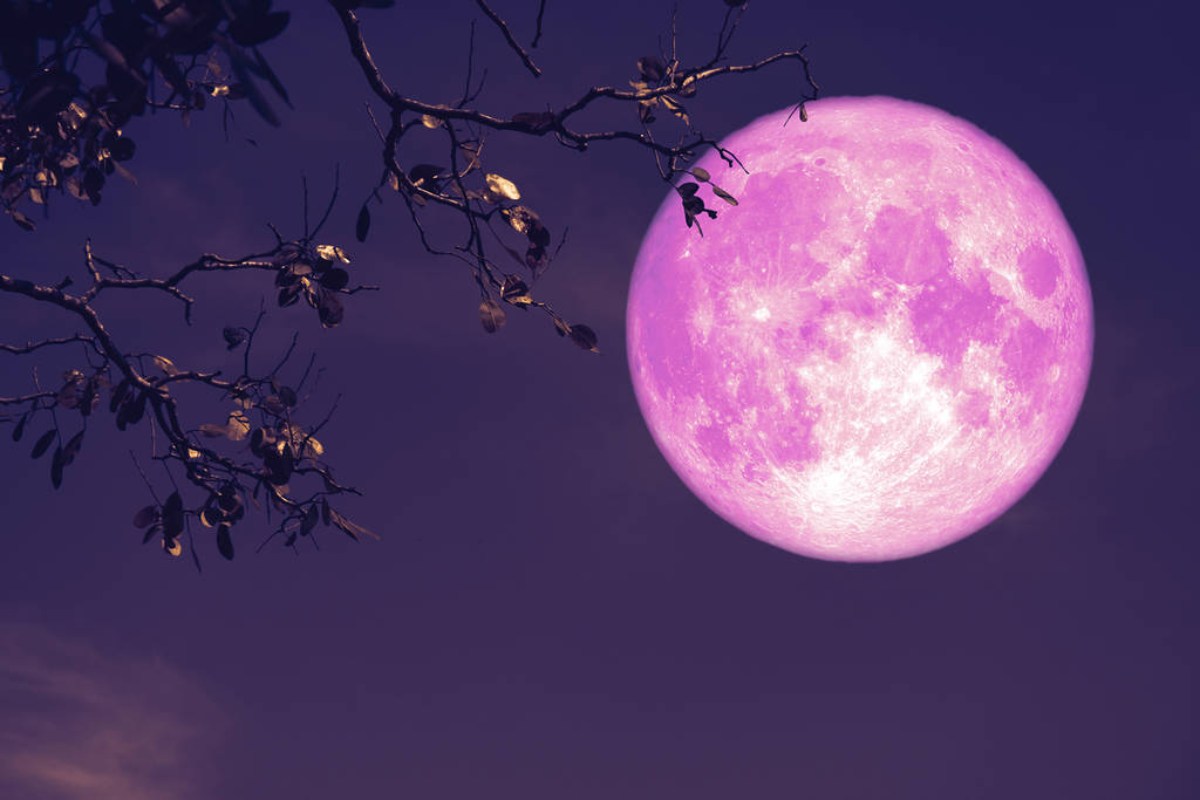
Get ready to witness the first full moon of summer as the spectacular Strawberry Moon rises tonight (June 29).
The moon will officially reach its full phase at 7:57 p.m. EDT (2357 GMT) on June 29, when it stands opposite the sun in Earth’s sky and appears completely illuminated. Although that marks the precise moment of the full moon, Earth’s natural satellite will look bright and nearly perfectly round for a night or two both before and after the peak.
The Strawberry Moon is scheduled to rise in UK skies tonight, becoming the first full Moon of the summer season.
According to the Royal Observatory Greenwich, it will reach its maximum illumination during the early hours of Tuesday, 30 June.
However, skywatchers hoping for a more convenient viewing time will still see it appearing full in the night sky on Monday, 29 June, as well as on the following evening.
Across the Northern Hemisphere, June’s full Moon differs from the others throughout the year because it remains the lowest above the horizon.
As a result, it appears closer to the horizon, creating the effect known as the Moon illusion, a visual phenomenon that makes the Moon seem larger than when it is positioned much higher in the sky during other times of the year.
June’s full moon will be the lowest full moon of the year because it occurs close to the summer solstice, when the sun reaches its highest position in the daytime sky. Since a full moon always appears opposite the sun, it follows the reverse path across the sky, tracing the year’s lowest arc.
Look toward the eastern horizon shortly after sunset to watch the Strawberry Moon rise into the evening sky among the stars of the constellation Sagittarius.
June’s full moon is called the Strawberry Moon, a name associated with the brief strawberry harvesting season traditionally recognized by Native American tribes. According to Time and Date, other names for June’s full moon include the Rose Moon, Hot Moon, and Mead Moon.
Despite its name, the Strawberry Moon will not actually appear pink. Instead, it may display golden or orange shades as it rises. This occurs because the moonlight travels through a thicker layer of Earth’s atmosphere when the moon is low on the horizon, scattering shorter wavelengths of light and allowing warmer colors to become more prominent.
You may also notice the moon looking unusually large near the horizon. This is caused by the moon illusion, a visual perception effect that makes the moon appear bigger when viewed alongside distant landscape features.
Despite its name, the moon will not appear pink or red. According to NASA, the name “Full Strawberry Moon” originated from the Algonquin tribes in the northeastern United States. This full moon occurred during the month of June, when strawberries were ripening and ready to be harvested.
The space agency noted that the name “Strawberry Moon” has been passed down through generations and continues to be widely used today. Other cultures refer to it as the Rose Moon or Honey Moon, with each name connected to early-summer harvest traditions.
This year’s Strawberry Moon is also the first full moon following the June 21 summer solstice in the Northern Hemisphere. Because of that timing, it will travel along the lowest path across the sky of any full moon in 2026, remaining close to the southern horizon throughout the night.
The Strawberry Moon is the traditional name for June’s full Moon, but skywatchers may be surprised to discover that it does not necessarily appear pink or red.
Its name is linked to the season in which it occurs rather than the Moon’s actual color.
Named after the harvesting period observed by Indigenous Americans, it marked the time of year when wild strawberries were ready to be picked, according to the Old Farmer’s Almanac.
Historically, full Moons were assigned distinctive names to help people track time and observe the changing seasons.
When the Moon does appear pink, red, or orange, it is typically the result of atmospheric conditions, external.
After a record-breaking heatwave across the UK this week, cooler and fresher Atlantic air is expected to move into the region.
Along with lower temperatures, the forecast also points to more unsettled weather during the early part of the week.
Although many areas are expected to stay dry on Monday with sunny intervals, a low-pressure system will approach during the evening and overnight hours.
As a result, thicker cloud cover and spells of rain are forecast to spread eastward from the west on Monday night.
Most of the cloudy and wet conditions are expected across Scotland, Northern Ireland, and northern England, while the Midlands, Wales, and southern England are likely to have the best opportunities for clear skies.
If poor weather prevents you from seeing this full Moon, there will be two additional chances during the meteorological summer.
The Buck Moon, named after the period when male deer begin growing new antlers, will rise on 29 July. It will be followed by the Sturgeon Moon, named after the freshwater fish traditionally caught by Native Americans in the Great Lakes, on 28 August.
The Championships at the All England Lawn Tennis and Croquet Club — widely recognized as… Read More
The 139th edition of the Wimbledon Championships brings together many of the world's top tennis… Read More
Investing in the stock market has become easier than ever, thanks to digital platforms and… Read More
Advances in DNA research have revolutionized our understanding of biology, health, and the human body… Read More
Google Finance is far from a new service—it has existed for two decades, dating back… Read More
Off-price retail has quietly become one of the most resilient corners of the entire shopping… Read More
