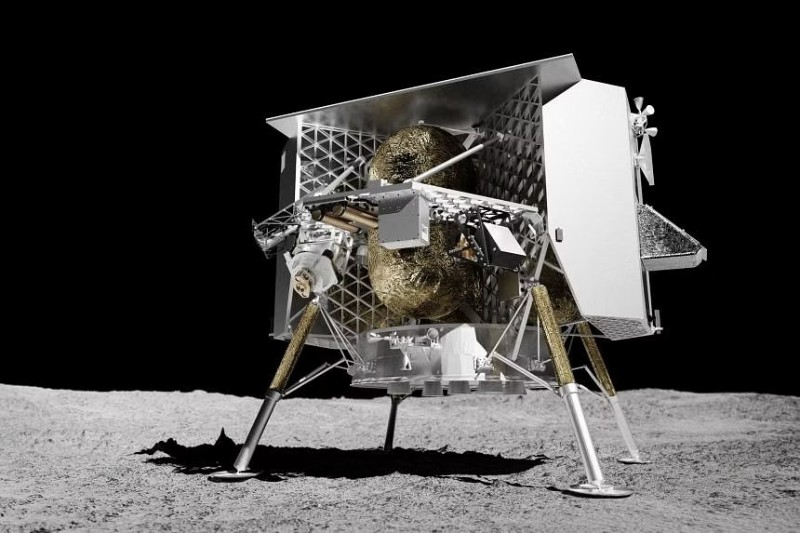
The head of what might be the first private company to successfully land on the moon said that the United States will attempt to land a craft on the moon again on January 25, more than 50 years after the last Apollo mission.
There will be no one on board the lander, Peregrine. It was created by the American company Astrobotic, whose CEO, John Thornton, stated that the spacecraft would be equipped with NASA equipment to investigate the lunar surface ahead of NASA’s manned Artemis missions.
NASA decided to launch the CLPS program a few years ago, which involves US companies sending scientific experiments and experiments to the Moon.
These fixed-price agreements ought to facilitate the growth of a lunar economy and lower the cost of transportation services.
At a press conference held on Wednesday at his company’s Pittsburgh headquarters, Thornton stated, “One of the big challenges of what we’re attempting here is attempting a launch and landing on the surface Moon for a fraction of what it would otherwise cost.”
“Only about half of the missions that have gone to the surface of the Moon have been successful,” he stated.
“So it’s certainly a daunting challenge. I’m going to be terrified and thrilled all at once at every stage of this.”
December 24 is the planned launch date from Florida for the new rocket from the ULA industrial group, known as Vulcan Centaur.
After entering lunar orbit, the probe will take “a few days” to return, but Thornton said that to ensure that the lighting at the intended landing site is ideal, a landing attempt cannot be made until January 25.
Without human assistance, the descent will be carried out autonomously, but it will be watched over from the company’s control center.
The Japanese start-up ispace had already attempted to land on the moon as the first private company in the spring, but the mission failed. In 2019, Israel experienced a setback as well. Only four nations—the US, Russia, China, and, most recently, India—have made successful moon landings.
NASA has agreements with Firefly Aerospace, Draper, and Intuitive Machines in addition to Astrobotic.
The latter is scheduled to launch in January atop a SpaceX rocket.
According to Chris Culbert, the CLPS program manager, “NASA leadership is aware of the risks and has accepted that some of these missions might not succeed.”
“But even if every landing isn’t successful, CLPS already had an impact on the commercial infrastructure needed to establish a lunar economy,” he said.
NASA intends to build a base on the moon through the Artemis program.
On Aug. 12, 2026, millions of people across Spain will observe a solar eclipse. The… Read More
ZAGREB, Croatia — Access to credit has long depended on geography in many parts of… Read More
Gout is a form of arthritis that often appears suddenly, causing painful joint inflammation and… Read More
BTS, Cardi B, and Lainey Wilson are among the artists scheduled to perform at the… Read More
The 2026 World Cup is shaping up to be the tournament of excess. The largest… Read More
Most people are taught to believe success has a deadline. That dreams should be achieved… Read More
