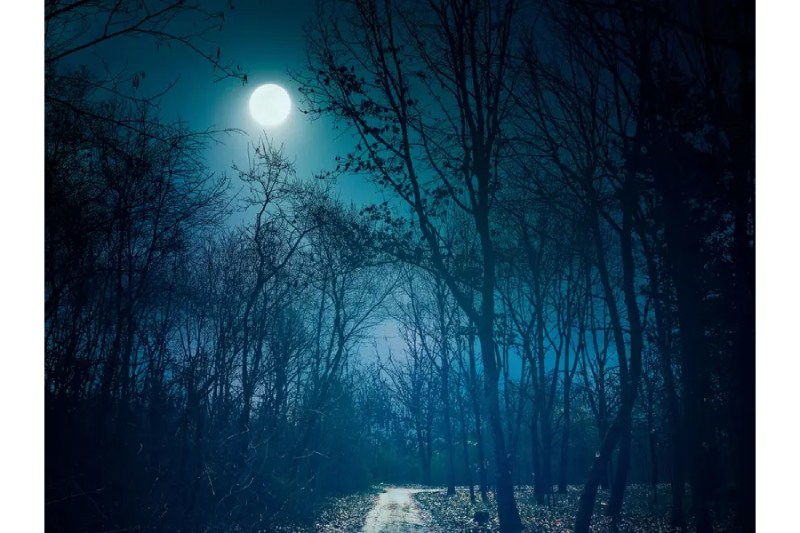
May’s rare blue moon is still yet to arrive, giving skywatchers another opportunity to witness a full moon before June begins. The second full moon of the month — known as a blue moon — will rise on May 31, marking one of the more unusual lunar events on the calendar.
You’ve likely heard the phrase “once in a blue moon.” You may have even used it to describe an infrequent event in your own life — how often you purchase a new cellphone, for instance.
However, this weekend will showcase a genuine blue moon: the second full moon to appear in the sky within a single month.
The celestial occurrence takes place around seven times every 19 years or approximately every two to three years, according to EarthSky.
The lunar cycle consists of eight moon phases and lasts 29.5 days — slightly shorter than the length of a typical month. Due to this difference, some months occasionally experience two full moons. The second of these full moons is known as a blue moon — more specifically, a calendrical blue moon.
At times, a single year can even include two blue moons. In 2018, both January and March featured two full moons, while February had none. The next occurrence of this phenomenon is expected in 2037, according to The Old Farmer’s Almanac.
This is unusual because the moon requires 29 and a half days to move through its various phases — the changing shapes visible from Earth — meaning a full moon generally occurs once each month. “But occasionally you’ll get two, and the second one is referred to as a blue moon,” Brown says, noting that this is the type of blue moon taking place this weekend.
Another variety is called a “seasonal blue moon”. In this instance, the term refers to an “extra” full moon during an astronomical season — the span of time between a solstice and an equinox, or an equinox and a solstice.
A different kind of blue moon is the seasonal blue moon. This happens when four full moons, instead of the usual three, occur within a three-month season. Within that sequence, the third full moon is known as the blue moon. The next seasonal blue moon is set to rise on May 20, 2027.
This month’s blue moon is also classified as a micromoon, meaning it will appear slightly smaller and dimmer than a standard full moon.
This occurs because the full moon takes place near apogee — the point in the moon’s orbit where it is farthest from Earth.
Blue moons occur every few years, while micromoons happen two or three times annually. According to Brown, this means a blue micromoon appears roughly once every couple of decades.
However, these events are not regular, and two such occurrences may happen closer together or farther apart. Additionally, Brown notes that factors such as time zone differences and the international date line can lead different parts of the world to disagree on whether a particular full moon qualifies as a blue moon.
Using the same definition applied to the upcoming blue micromoon, Brown says the next occurrence for the UK appears to be in 2066 — although some regions of the world, including the US, will experience one in 2053.
Blue moons are uncommon, but they are not exceptionally rare.
Following May 2026, the next blue moons are anticipated in May 2027 and December 2028, according to the Royal Museums Greenwich.
There are two types of blue moons:
The May 31 event is categorized as a calendrical blue moon.
No — although a separate phenomenon can make the moon appear blue. As Brown explains, this may happen when there are major forest fires or volcanic eruptions.
Despite its colorful name, Earth’s natural satellite will appear in its usual silvery-white or golden shade.
The phrase “the moon is blue” dates back to the 1500s and was used to describe something believed to be impossible, which is where the expression “blue moon” originated, according to Britannica.
However, the 1937 Maine Farmer’s Almanac was where the phrase was first recorded, and it remained in use, gradually evolving into the astronomical term recognized today, noted Dr. Pamela Gay, senior scientist at the Planetary Science Institute.
It is, however, possible for the moon to look blue when Earth’s atmosphere contains smoke or dust particles that are slightly wider than 900 nanometers, although this is a rare event. In 1883, people reported seeing the moon appear blue after the eruption of Indonesia’s Krakatoa volcano, according to Britannica.
The precise time of the full moon on May 31 is 9.45 am BST (4.45 am Eastern Time in the US; 6.45 pm AEST in Australia).
For observers in the UK, that is well after moonset. But Brown says: “It will be indistinguishable from being full the entirety of the night beforehand and basically the night after as well.” In other words, the best viewing opportunity will be on Saturday or Sunday night.
In the Northern Hemisphere, Brown says the moon will remain relatively low in the sky throughout the night, while in the Southern Hemisphere, it will appear much higher.
May’s blue moon will reach its fullest phase, or peak, at 4:45 a.m. ET on Sunday before sunrise. The event will also feature a micromoon, meaning it will be near the most distant point from Earth in its orbit, according to EarthSky.
Because the moon’s orbit around Earth is not a perfect circle, its apparent size changes by roughly 10% at various points in its orbit, Gay said. The closest point is known as perigee, and the farthest point is called apogee. A full moon occurring near apogee is known as a micromoon — and the upcoming event will be the most distant full micromoon of the year.
Sunday’s moon will be approximately 252,334 miles (406,093 kilometers) from Earth, compared to its average distance of about 238,855 miles (384,400 kilometers), according to NASA. Nevertheless, the silvery moon will not appear noticeably smaller to the naked eye.
The previous calendar blue moon, which occurred in 2023, was not a micromoon. In fact, it was the opposite — a supermoon, which happens when a full moon coincides with perigee, its closest point to Earth. At perigee, the moon is approximately 226,000 miles (363,300 kilometers) from Earth, according to NASA.
For North and South America, Africa, and Europe, the moon will appear fullest on the night of May 30. Australia, New Zealand, and Asia will experience the brightest full moon on the night of May 31.
The next full moon following May’s blue moon will be the strawberry moon on June 29.
The June full moon is expected to reach its peak at 7:57 p.m. ET, according to Space.com.
Diwali is not one mood. It is many. There's the quiet pooja in the morning.… Read More
Spotify revealed on Wednesday that it is broadening audiobook availability to more than 180 markets… Read More
A family business proves its relevance each time a new generation finds something worthwhile to… Read More
Sometimes, the biggest opportunities begin when you realize you have outgrown where you are. For… Read More
Apple started introducing Apple Pay in India on Tuesday. Axis Bank, the country's third-largest private-sector… Read More
As all-in-one AI agents such as Meta’s Muse and Instinct gain momentum, Google has announced… Read More
