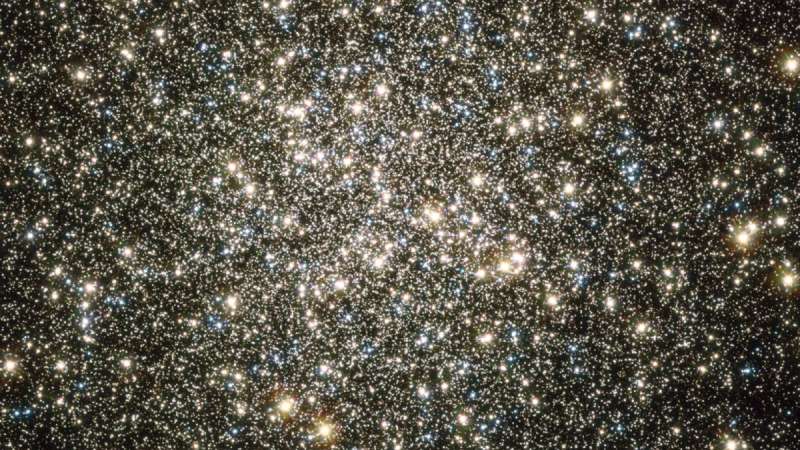
Northern-hemisphere skywatchers will have the opportunity to see three spectacular star clusters on warm mid-August summer nights in the upcoming months.
Star clusters are groups of stars that are gravitationally connected and originated from the same interstellar cloud. These stellar hives are classified as open clusters or globular clusters and range in size from a dozen to hundreds of members.
Typically, open star clusters are found in the Milky Way’s thick spiral arms, where over millions of years, the gravity of passing stars can pull at their outermost members, causing them to separate. Globular clusters, on the other hand, are typically located above and below the disk in the galactic halo.
Some of the earliest stars in our galaxy can be found in these closely packed, spherical swarms, which can contain hundreds of thousands of stellar bodies.
There are more than 1,000 open star clusters and about 150 globular clusters in the Milky Way, some of which are so brilliant that they can be seen with the naked eye from a dark sky location as a milky smear of light. Allowing your eyes to adjust to the darkness and scan with averted vision (focusing on places slightly off-center) can make it simpler to notice the deep space targets. This is because the rods, which are light-detecting cells that are excellent at “scotopic” low-light vision, are focused in these locations.
A stellar cluster’s light will be more sharply focused when viewed via 10×50 binoculars, and you may even be able to resolve some of its brighter constituent stars. The truly majestic nature of the amazing star cities that fill the night sky will become more apparent with the aid of a telescope with an aperture of six inches or more.
According to EarthSky.org, the Great Hercules Cluster, also known as Messier 13, is located in the constellation Hercules, which lies nestled between the brilliant stars Vega and Arcturus, approximately 25,000 light-years from Earth.
When you find it in the hours after sunset, look for the ‘Keystone’ asterism, a diamond-like formation of four stars at the heart of the constellation. An astronomy app on your phone can direct you directly to your destination if you need a little assistance.
You can see the ancient light emitted by the 100,000-strong stars of the Hercules globular cluster by sweeping your binoculars or telescope between Zeta Herculis and Eta Herculis, the two Keystone stars nearest to the neighboring constellation Bootes.
In August, the constellation Taurus can be seen flashing to the upper right of Venus and Jupiter on the eastern horizon in the hours before dawn. To the right of the bull’s two horns, Elnath and Tianguan, the Hyades can be seen as a sideways ‘V’ formation of stars that symbolizes the bull’s face (Zeta Tauri).
The Hyades is one of the nearest open star clusters to Earth, at 150 light-years away. The bull’s ‘right eye’, the red star Aldebaran, is only 65 light-years away from us, but it looks like it belongs to the cluster.
One of the most well-known open clusters in the night sky is the Pleiades. It is home to more than a thousand white-blue stars, but when observed via binoculars, its seven brightest members dominate the sky, earning it the nickname “Seven Sisters.”
The Pleiades will be around 10 degrees above the Hyades in the early morning sky in mid-August, which is about the width of your clenched fist held at arm’s length.
September is offering skywatchers several opportunities to observe notable events. Venus will reach its greatest… Read More
SIU Swiss International University, a member of the VBNN Smart Education Group, has officially opened… Read More
Why portfolio structure and the Gastauer Foundation matter after the June 2026 AUM revaluation The… Read More
Apple officially revealed its next-generation products tonight, introducing some of the most significant changes in… Read More
Apple has officially introduced the release candidate (RC) build of macOS 27, known internally as… Read More
Siri AI, Apple's long-awaited overhaul of its digital assistant, will become available in five additional… Read More
