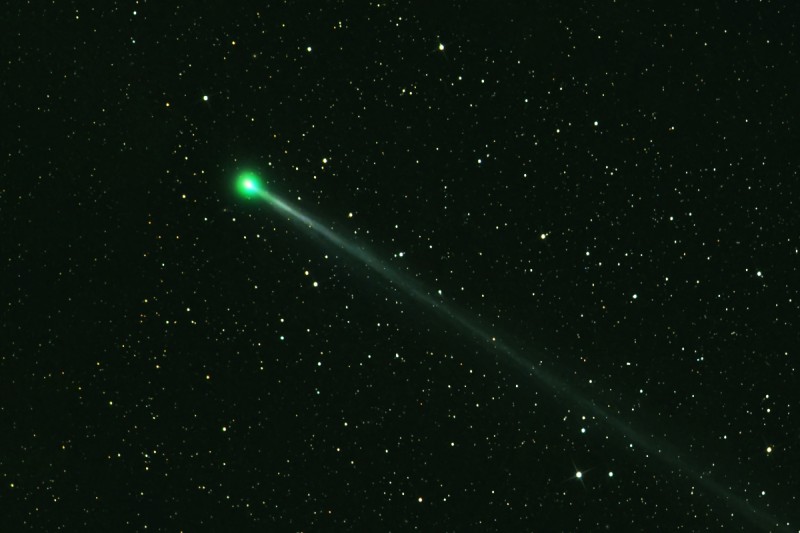
Later this month, a rare green comet that was just spotted in August might be seen in the Australian sky. The comet, officially known as C/2023 P1, will pass directly over Earth for the first time in 437 years. It is about a kilometer wide, and according to specialists, you may witness it for yourself in a few days.
According to NASA, the comet was discovered on August 12 by Japanese space photographer Hideo Nishimura using a standard digital camera. Nishimura gave the comet its name after this discovery. Its brightness has since grown, and its path through the inner Solar System has been identified. Comets are called “dirty snowballs” because they are composed of ice, rock, and soil. The high gas concentration in Nishimura is what gives it its green color, though.
Since comets are unexpected, Nishimura may be killed by the Sun’s strong heat because it is traveling closer to the Sun than Mercury. However, there is a potential that Nishimura will survive and unexpectedly brighten, becoming apparent to the naked eye. The last time it passed close to the Sun (and possibly came closer to Earth) was around the year 1590, before the invention of the telescope, according to Dr. Paul Chodas, director of NASA’s Center for Near Earth Object Studies. This celestial event only occurs once every 430 to 440 years. As a result, it won’t be apparent until at least 2458.
The optimum window for viewing the comet in Australia will be from September 20 to 27, when its head will set around an hour after the sun. On September 23, it will be the farthest from the Sun.
Since this may be our only opportunity to see the comet, experts have provided some helpful advice to ensure your greatest chance of catching a look.
You’ll need to get up before sunrise if you want to see it before it disappears. In the hours before dawn, locate the Leo constellation on the eastern horizon. Binoculars or a small telescope will be necessary for the best view. If you’re looking for some additional resources to help you find the comet, have a look at this list of astronomy apps by Space.
Record five-time world champions Brazil will aim to begin their 2026 FIFA World Cup Group… Read More
The year 2026 has become especially significant for astronomers and skywatchers, with four eclipses scheduled… Read More
Qatar will be aiming to secure their first-ever World Cup victory when they face Group… Read More
It has been 115 days since the Seattle Seahawks captured the Super Bowl title. Fortunately… Read More
In an effort to promote awareness of India’s rich cultural legacy and traditional knowledge systems,… Read More
The 2026 FIFA World Cup begins on home turf for the United States as they… Read More
