Prodrome
The ever-evolving IT companies offer a variety of cloud services to businesses today. Solutions such as IaaS (Infrastructure as a Service), PaaS (Platform as a Service) and SaaS (Software as a Service) are capable of solving numerous business challenges without significant costs. As part of our today’s topic about Kubernetes (K8s), the mention of these cloud services, especially IaaS and PaaS, is quite relevant. Firstly, it is on the basis of K8s that PaaS can offer its platform, and, secondly, the K8s platform itself can be successfully deployed as a service based on IaaS. All of the above as well as other systems of interaction between various Internet solutions can be represented as Kubernetes supporting.
Containerization
So, today we are talking about the open Kubernetes platform, which, moreover, demonstrates a successfully developing ecosystem. The second name or numeronym for this software is K8s (k-eights), in which, quite cleverly, the eight letter characters between “K” and “s” have been replaced by the numeric character “8”. But the point, of course, is not in the name, although the history of its appearance, like the Kubernetes logo, is very interesting. The main thing about this software is that it can be used to successfully deploy CApps (containerized applications), as well as manage and scale them. Since CApp is one of the main terms, without which it is impossible to talk about Kubernetes, explaining its essence becomes not only important, but also a necessary addition to today’s topic..
At the dawn of IT technologies, computers often did not live up to the expectations of their users, since when several applications were installed on them, the speed and efficiency of their work drastically decreased due to a lack of resources. Only one program could be launched on one server. Then with the advent of the so-called computer file (image), called the “virtual machine” (VM), the situation with resources has improved significantly. Figuratively speaking, another computer, only virtual (software), appeared in the user’s physically tangible computer. However, despite its virtual nature, the VM was not much different from a regular computer, as it had all its components – a processor, memory, an Internet connection, etc. But progress, as you know, does not stand still, and an improved version of the VM – container – has appeared. Its innovativeness lied in the fact that this package was not demanding on resources, was extremely isolated and used the capabilities and means of the host OS, and not a physical computer or a remote server, like a VM. Among other things, the container was attractive in one important characteristic – regardless of the form of its launch or transfer to another developer, it didn`t change its original configuration.
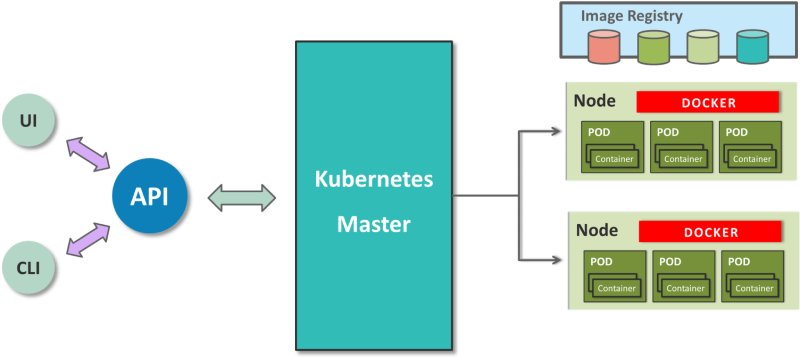
With the emergence of micro service architectures and the expansion of application logic, there was a need for container orchestration. And just the Kubernetes platform had become the software that was able to manage containers, transfer them between operating systems, perform complex launches in the presence of a large number of containers, etc. Like any large IT system, Kubernetes contains with unique components and, of course, has its own terminology. Cluster Kubernetes, nodes, containerized applications, pods, Control Plane are the main components of K8s software.
Let’s list the features that Kubernetes has.
1) K8s is able to monitor the functioning of the entire cluster, not only of the separate applications. At the same time, the information about the results of the work that the developer receives is intuitive.
2) K8s not only performs auto-monitoring of the load consumed by containers, but is also able to optimally distribute it in case of high traffic in any container.
3) In the event that a developer selects a specific storage system, K8s can automatically configure this system as well as it is required within a particular project.
4) K8s is exactly the platform on the basis of which it is possible to deploy applications in two modes: manual and automatic. This means that if a change is made only to some part of the container, this change can be delicately tested and, if necessary, returned to its original state.
5) K8s has the ability to auto-stop or re-start the container. This can happen in cases of container failures or incorrect operation. In this case, the redistribution of released resources occurs.
6) Privacy and security issues are also managed by K8s. All secret information related to SSH keys, OAuth tokens, passwords, etc. is preserved in sure.
Spotify is rolling out several significant updates to its mobile app, including Android support for… Read More
May's rare blue moon is still yet to arrive, giving skywatchers another opportunity to witness… Read More
Medellín, Colombia. At only 21 years old, Luis Ignacio Moreno Londoño is emerging as a… Read More
Chennai, India — Amwhiz, India's premier all-in-one Shopify service provider, today announced its complete suite… Read More
The USC Trojans are returning to the NCAA Tournament, but their journey toward Omaha will… Read More
ZAGREB, Croatia | Croatia’s digital finance sector continues to evolve rapidly in 2026, and one… Read More
