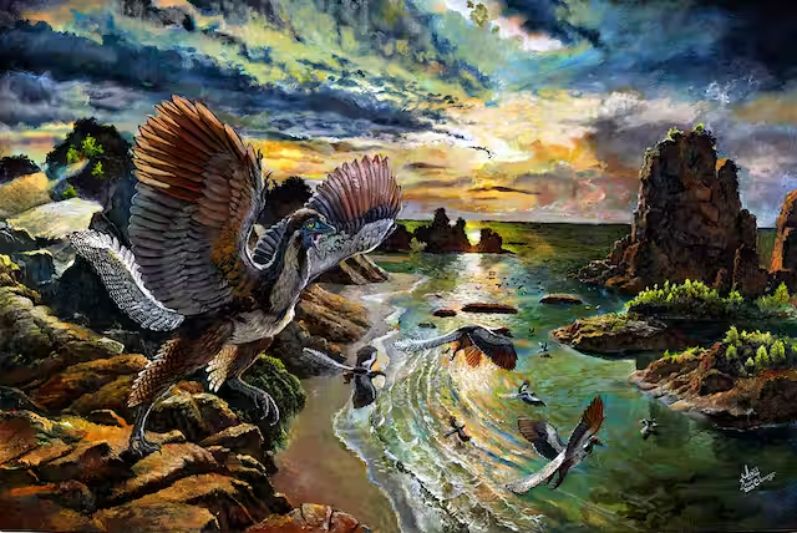
Scientists have discovered a dinosaur skeleton with intriguing bird-like characteristics among the preserved fossilised remnants of turtles and fish in a fossil bed in southeast China.
The discovery, which is thought to be around 30 million years older than any other known bird fossil, may provide some useful information on the crucial early stages of the evolution of birds.
To determine the animal’s position within the dino-bird family tree, palaeontologist Min Wang of the Chinese Academy of Sciences and colleagues compared the new fossil, called Fujianvenator prodigiosus, with the remains of dinosaurs from that period and more recent ones.
The scientists came to the conclusion that the pheasant-sized, possibly feathered Fujianvenator prodigiosus belonged to the same ancestry as contemporary birds and their most closely related dinosaur predecessors, the avialae family.
These early bird fossils are rare, therefore they individually contain crucial information on the evolution of birds and the environments they encountered on Earth.
To honour the tremendous diversity and distinctive composition discovered at that period and location in Earth’s history, researchers have called the collection Fujianvenator. It was discovered in Zhenghe Fauna.
For many years, a crucial early stage in the evolution of modern birds was defined by the well-preserved remains of a dinosaur called Archaeopteryx, which is 150 million years old.
Now, though, scientists aren’t so convinced, discovering that the fabled feathered species shares more traits with the Deinonychosauria than the Avialae. Researchers can only make educated guesses as to what such an early bird would have looked like because there aren’t many other compelling bird-like fossils from this era.
In between an ancient dinosaur and more contemporary birds, Fujianvenator appeared only a few million years after Archaeopteryx and may hold some of the answers.
The peculiar four-winged Anchiornis and other dinosaurs that resembled less birds have traits in common with the pelvis of Fujianvenator. This demonstrates that Fujianvenator diverged in a distinct direction from the one that produced birds and indicates that the morphological shift from arms to wings began very early in the evolution of birds.
The fossils it was discovered with and its lengthened lower hindlimbs show that Fujianvenator was either a long-legged swamp dweller or a fast runner.
These leg proportions are used for both running and wading, but sadly, Fujianvenator’s feet, which might discern between these alternatives, are not fully described, thus additional fossil finds will be required to confirm.
But this is the first instance of a possible swamp avian being found. All of the other avialans that have been found so far show characteristics of being tree dwellers.
A roof rarely fails all at once. It starts with a few lifted shingles after a windy… Read More
Spotify revealed on Wednesday that it is broadening audiobook availability to more than 180 markets… Read More
A family business proves its relevance each time a new generation finds something worthwhile to… Read More
Sometimes, the biggest opportunities begin when you realize you have outgrown where you are. For… Read More
Apple started introducing Apple Pay in India on Tuesday. Axis Bank, the country's third-largest private-sector… Read More
As all-in-one AI agents such as Meta’s Muse and Instinct gain momentum, Google has announced… Read More
