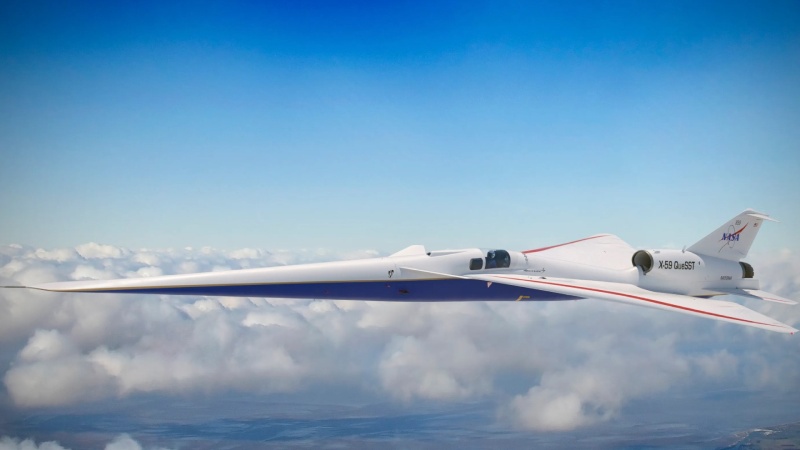
The “quiet supersonic” X-59, developed by Lockheed Martin and NASA, has finally been unveiled. This aircraft could significantly impact future commercial and military air travel.
After receiving a $248 million grant from NASA in 2018, Lockheed Martin Skunk Works began developing the X-59 years ago. That was only the first of several research projects that NASA planned to support to advance aviation in a big way, whether in terms of size, speed, or efficiency.
This is the first time the aircraft has been seen in public on the tarmac; previously, it has only been visible in the hangar during various stages of disassembly. Naturally, they caused quite a stir at Lockheed’s Palmdale facility.
“In just a few short years we’ve gone from an ambitious concept to reality. NASA’s X-59 will help change the way we travel, bringing us closer together in much less time,” said Pam Melroy, NASA deputy administrator, in a press release.
The X-59 is not a production aircraft prototype; rather, it is an experimental aircraft. The idea is to show that a plane can travel faster than the speed of sound, or in this case, 925 mph, without producing the pressure wave that causes a loud boom that rattles windows.
While completely minimizing the impact of a massive object traveling through the atmosphere at high speed is unachievable, the team wants to lessen the boom to a “sonic thump” that won’t harm people, property, or wildlife as much.
“By demonstrating the possibility of quiet commercial supersonic travel over land, we seek to open new commercial markets for U.S. companies and benefit travelers around the world,” said NASA’s Bob Pearce.
It essentially achieves this thanks to its extremely aerodynamic shape: With its dart-like profile, which is precisely engineered to break up the shock waves coming off it in flight, it is nearly 100 feet long and only 29.5 feet wide.
This shape has an interesting side effect in that it makes it impossible to have a forward-facing window in the cockpit; like the nosecone, it would have to be greatly attenuated. Instead, the group installed a 4K screen that they refer to as the eXternal Visibility System, or XVS, which transmits real-time images from the front.
There are still numerous tests to be completed before the plane can take off. Now that the weight is supported, however, they can proceed to “integrated systems testing, engine runs, and taxi testing” in preparation for the aircraft’s first flight, which is provisionally slated for “later this year.” There are plans for a subsonic flight, additional testing, and the historic first supersonic flight.
Naturally, other parties are interested in this type of flight besides Lockheed and NASA: Boom Supersonic is working diligently to develop a silent supersonic test aircraft. However, don’t expect to hear any loud noises over you anytime soon. Although the technology shows promise, widespread adoption is still years away.
Google’s newest Gemini app update for macOS prepares support for local iMessage integration. The development… Read More
iOS 27 launched this week as a major update for the iPhone, and here are… Read More
With iOS 27 now available, CarPlay receives its most significant refresh in years. However, which… Read More
Google left out one detail from its announcement about the new Search profiles features revealed… Read More
Samsung Electronics Co., Ltd. has announced that One UI 9 is expanding to additional Galaxy… Read More
September is offering skywatchers several opportunities to observe notable events. Venus will reach its greatest… Read More
