
News
Norfolk Island pine (Araucaria heterophylla) of the family Araucariaceae.


Although the natural range of Norfolk Island pine is confined to that tiny speck of 34 square kilometers of land in the South Pacific midway along a line between New Caledonia and New Zealand, this species and monkey puzzle tree (Araucaria araucana) are the two most familiar araucarias in cultivation outdoors in warm and moderate climates, contributing some of the most architectural tree forms to the cultivated landscape.
Norfolk Islands pine is also a common greenhouse subject and indoor accent plant in cooler climates. It is as well one of the most characteristic landscape features of its native Norfolk Islands. Despite the narrowness of this natural range, it is a common tree on the island, and there is no evidence of restricted genetic variation (at least no more so than in other species of Araucaria). In fact, there are more cultivars of Norfolk Island pine, varying in needle length, shape, and color, than there are for all of the other species combined (except for monkey puzzle tree, which has a similar number).
While mature foliage is rare in cultivation and effectively absent indoors, the striking differences between juvenile and adult foliage are responsible for the species name (Latin for “different leaves”), especially in comparison to the much more uniform monkey puzzle tree, the only other Araucaria familiar to botanists at the time that Araucaria heterophylla was described. Because of earlier confusion with the similar Cook pine(Araucaria columnaris), this species has been mistakenly called Araucaria excels, a synonym of that New Caledonian species.
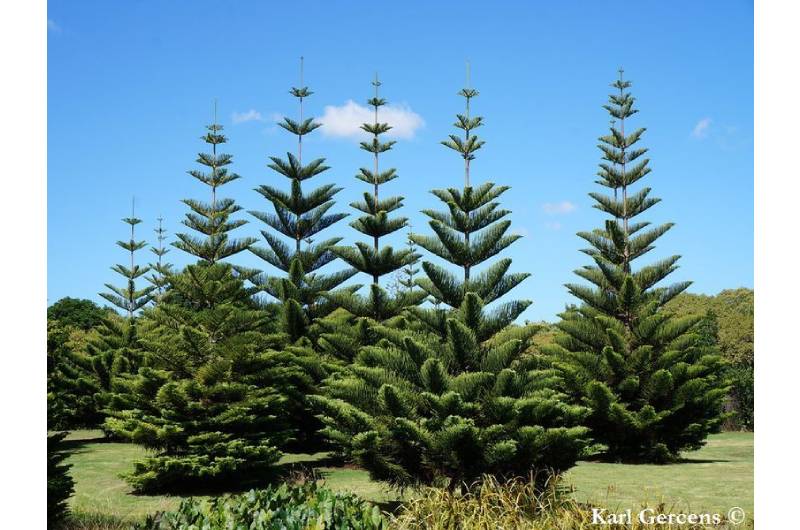
Cultivated plants sold as Norfolk Island pine are often Cook pines, especially those originating as nursery stock from Hawaii. Norfolk Island pine has a much wider branch spread, longer leaves, smaller pollen and seed cones, and narrower cotyledons (only 1.5 mm wide versus 3.5 mm) than Cook pine. Despite their strong similarity, the two species are not particularly closely related. DNA studies show that Cook pine is closest to the other New Caledonian species, whose relationships are too messy to be resolved as yet, while Norfolk Islands pine is sister to the whole New Caledonian group and thus no more closely related to Cook pine than to of the other species.



Choosing a Roof That Lasts: A Homeowner’s Material Checklist

Spotify Extends Audiobook Availability to More Than 180 Markets Worldwide

How Fahad Riaz Is Taking a Four Decade Family Legacy Forward With Milele Prime

Alicia Lacao-Green gains worldwide fame owing to her amazing transformations via make-up and contouring.

Amplifyou, an amazing agency for eCommerce

Vasid Qureshi, India’s Top Blogger Shares 5 Tips to Go Viral on Social Media

Choosing a Roof That Lasts: A Homeowner’s Material Checklist
A roof rarely fails all at once. It starts with a few lifted shingles after a windy week, a damp patch on...

Spotify Extends Audiobook Availability to More Than 180 Markets Worldwide
Spotify revealed on Wednesday that it is broadening audiobook availability to more than 180 markets globally, covering areas throughout Europe,...

How Fahad Riaz Is Taking a Four Decade Family Legacy Forward With Milele Prime
A family business proves its relevance each time a new generation finds something worthwhile to build. For Fahad Riaz, Milele...


Outgrowing Isn’t Giving Up: Hayson Tasher Sr. on Choosing Growth
Sometimes, the biggest opportunities begin when you realize you have outgrown where you are. For Hayson Tasher Sr., that realization...


Apple Pay Launches in India With Axis Bank as First Banking Partner
Apple started introducing Apple Pay in India on Tuesday. Axis Bank, the country’s third-largest private-sector lender, is its first banking...
-

 Sports3 weeks ago
MLB 2026 Playoffs: Full Postseason Schedule, Wild Card and World Series Dates, Games, and TV Networks
-

 Science3 weeks ago
September 2026 Full Moon: When, Where, and How to See the Harvest Moon
-

 Tech3 weeks ago
Google Will Replace Gemini Gems With Skills in November 2026
-

 Tech4 weeks ago
Google Gemini for macOS Adds Support for Apple Messages
-

 Tech4 weeks ago
Startup Compliance Checklist: Product Registrations Before You Scale in 2026
-
 Gadget3 weeks ago
How to Customize AirPods Settings in iOS 27
-

 Tech4 weeks ago
iOS 27 Brings Major CarPlay Changes With Car-Dependent Features
-

 Business3 weeks ago
Gastauer Family Office Gives Nature Finance A Longer Time Horizon