
Travel
World’s Oldest and Longest man-made river ‘Beijing-Hangzhou Grand Canal’ Open to Tourists in North China’s Cangzhou Downtown Section

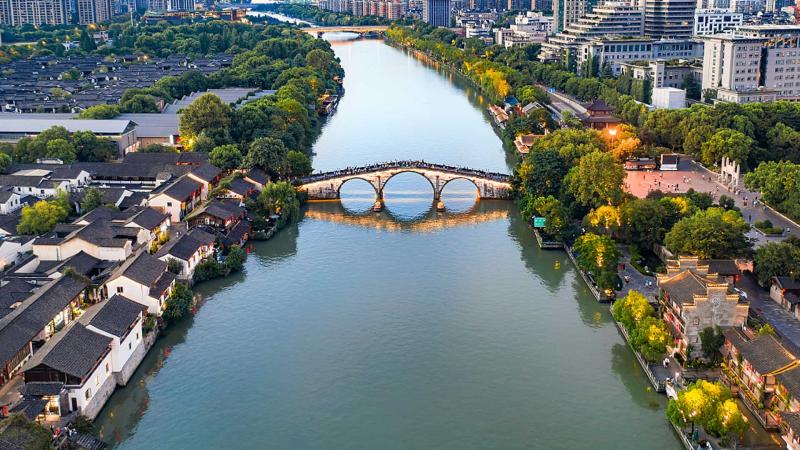
The Cangzhou city downtown section of the world’s oldest and longest man-made river, the Beijing-Hangzhou Grand Canal, is available to navigation for tourism on September 1 and will allow guests an opportunity to appreciate the masterpiece of old China’s artificial waterway, announced an official with the Cangzhou city government of north China’s Hebei Province.
“We and more than 230 representatives from all walks of life in the city gathered to witness the historic moment of the opening of tourism in the Cangzhou central urban area of the Beijing-Hangzhou Grand Canal,” said Xiang Hui, mayor of Cangzhou at the opening ceremony, adding that the Grand Canal is now ushering in a new century of revival.
‘Beijing-Hangzhou Grand Canal’ Open to Tourists in North China
The kickoff of the 13.7-kilometer-long Cangzhou section of the Grand Canal is a significant move to propel the organized development of the Beijing-Tianjin-Hebei region in North China.
The Beijing-Hangzhou Grand Canal is 1,794 kilometers (1,115 miles) in length and has a history of 2,500 years. It begins in Beijing in the north and closed in Hangzhou in the south and served as a huge transportation artery in ancient China. Around one-eighth of the Canal goes through Cangzhou, 180 km away from Beijing. A stretch of over 1,000 km of the canal was proclaimed a world heritage site in 2014.
Cangzhou, known as “Northern Town of the Grand Canal”, has upgraded the supporting projects along the Grand Canal, recently constructed 12 tourist piers, and six landscape walking bridges, and remodeled 8 existing main bridges. The city strives to give a unique destination for tourists at home and abroad by taking the Grand Canal as the center and bringing efforts into saving historical and cultural projects, for example, the Hundred Lions Garden, Canal Park, Nanchuanlou Cultural Block, Garden Expo Park, Children’s entertainment, sports park, catering, and accommodation facilities.
Shanghai plans to reopen more organizations, and Beijing fights against Covid-19
To cause Grand Canal to recover its vitality, Cangzhou has actively implemented water diversion and water replenishment projects in recent years. Given the diversion of 180 million cubic meters of water in 2021, one more 300 million cubic meter of water was finished for this present year. More than 67,000 stems of arbor trees were established on the two sides of the Canal, with a green area of 2,065 mu (1.37 square kilometers), forming a vibrant ecological corridor, and building up the greening and upgrading projects. Cangzhou has genuinely “protected, passed down and made good use of” the Grand Canal culture and made this valuable heritage blossom into a new era.
Fifteen cruise ships have lined up by the piers for their first rides. From September 1st, tourists will actually want to experience Cangzhou’s historical and cultural relics along the Grand Canal.



Spotify Extends Audiobook Availability to More Than 180 Markets Worldwide

How Fahad Riaz Is Taking a Four Decade Family Legacy Forward With Milele Prime

Outgrowing Isn’t Giving Up: Hayson Tasher Sr. on Choosing Growth

Alicia Lacao-Green gains worldwide fame owing to her amazing transformations via make-up and contouring.

Amplifyou, an amazing agency for eCommerce

Vasid Qureshi, India’s Top Blogger Shares 5 Tips to Go Viral on Social Media

Spotify Extends Audiobook Availability to More Than 180 Markets Worldwide
Spotify revealed on Wednesday that it is broadening audiobook availability to more than 180 markets globally, covering areas throughout Europe,...

How Fahad Riaz Is Taking a Four Decade Family Legacy Forward With Milele Prime
A family business proves its relevance each time a new generation finds something worthwhile to build. For Fahad Riaz, Milele...

Outgrowing Isn’t Giving Up: Hayson Tasher Sr. on Choosing Growth
Sometimes, the biggest opportunities begin when you realize you have outgrown where you are. For Hayson Tasher Sr., that realization...


Apple Pay Launches in India With Axis Bank as First Banking Partner
Apple started introducing Apple Pay in India on Tuesday. Axis Bank, the country’s third-largest private-sector lender, is its first banking...


Google Will Replace Gemini Gems With Skills in November 2026
As all-in-one AI agents such as Meta’s Muse and Instinct gain momentum, Google has announced that it is discontinuing the...
-

 Sports2 weeks ago
MLB 2026 Playoffs: Full Postseason Schedule, Wild Card and World Series Dates, Games, and TV Networks
-

 Science2 weeks ago
September 2026 Full Moon: When, Where, and How to See the Harvest Moon
-

 Tech3 weeks ago
Google Adds Search Profile Badge for Websites
-
Tech2 weeks ago
Google Will Replace Gemini Gems With Skills in November 2026
-

 Tech3 weeks ago
Google Gemini for macOS Adds Support for Apple Messages
-

 Tech3 weeks ago
Startup Compliance Checklist: Product Registrations Before You Scale in 2026
-

 Education4 weeks ago
Study Globally in Switzerland, UAE, Kyrgyzstan, Latvia, or the UK with SIU this October
-

 Tech3 weeks ago
Samsung One UI 9 Adds My FanCam and Smarter Galaxy AI Features