
Tech
Rana Gujral’s TEDx Talk: Probing the Mind’s Crafted Reality

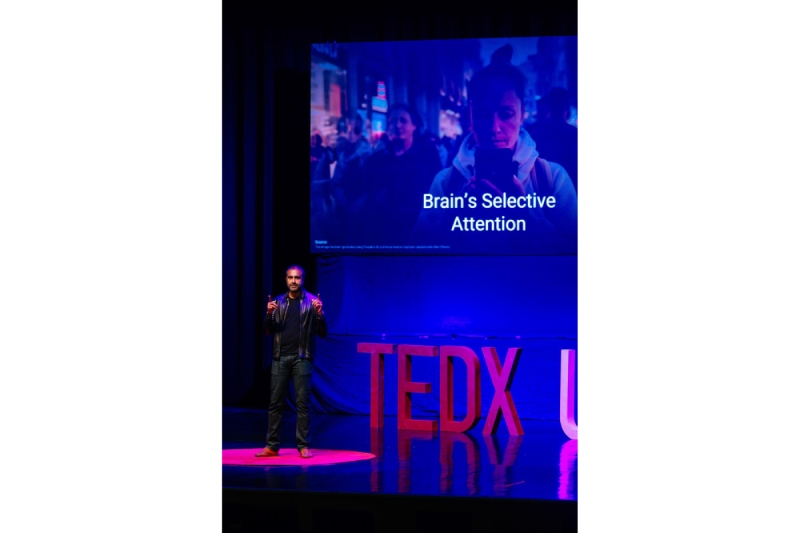
Rana Gujral, CEO of Behavioral Signals, an AI startup focused on cognitive AI, delivered a compelling TEDxUPV talk, “The Brain’s Dream: How Our Minds Shape Reality,” uploaded to the TEDx YouTube channel on March 3, 2025 (https://youtu.be/gcV1um7kOMw?si=AlBSfwO9UOSBpDI). A Forbes Technology Council member and seasoned entrepreneur, Gujral leverages his deep learning expertise to explore how our brains construct reality. This article examines two central themes from his talk—the brain as a shaper of perception and the self as a neural construct—focusing on their scientific grounding and ties to Gujral’s work, while presenting a clear, well-crafted narrative.
Rana Gujral: From AI Innovation to TEDx Insights
Gujral introduces himself as an entrepreneur leading Behavioral Signals, where he develops AI to analyze human behavior through voice data. With leadership roles at Logitech, UKG and Cricut, Gujral’s experience in AI and cognition informs his TEDx talk. Delivered in a conversational style, the talk uses neuroscience and optical illusions to question how we perceive reality, showcasing his ability to distill complex ideas into engaging insights.
The Brain as Perception’s Architect
Gujral challenges the notion that our eyes capture reality like a camera. “Your brain doesn’t just receive what your eyes see—it creates a production,” he says, citing David Eagleman’s The Brain: The Story of You. He illustrates this with the Checker Shadow Illusion, where two identical squares appear different due to context, as shown in Edward Adelson’s research. The Hollow Mask Illusion further highlights this: a concave mask appears convex because the brain expects faces to protrude, per Richard Gregory’s *The Intelligent Eye*. “Even when you know it’s an illusion, your brain insists,” Gujral observes, emphasizing neural expectations over sensory input.
This extends to all perception. Colors like “red” are brain interpretations of light wavelengths, not inherent properties, as Semir Zeki’s *Inner Vision* notes. Selective attention, per Anne Treisman’s studies, filters out irrelevant details, crafting a tailored reality. Gujral connects this to his AI research at Behavioral Signals, where neural networks detect universal emotional patterns across languages, suggesting the brain relies on shared mechanisms to build perception. This perspective underscores that our reality is actively constructed, aligning with his work on human behavior.
The Self as a Neural Construct
Gujral’s second theme questions identity. “The ‘you’ inside your head might be an illusion,” he suggests, referencing Sam Harris’s *Waking Up* and David Hume’s *A Treatise of Human Nature*. The self, he argues, emerges from neural connections, not a fixed entity. Memory shapes this, as Elizabeth Loftus’s research on memory reconstruction shows: past experiences create a cohesive identity, akin to how the brain constructs visual reality. The Hollow Mask Illusion parallels this—expectations shape not just what we see but who we think we are.
Gujral concludes by asking, “What is reality, really?” Rooted in his AI insights, this question resonates with psychology and technology, where perception is key. Blending science and accessible examples, his talk invites us to explore the mind’s role in shaping our world, offering a nuanced view of reality and self.













Rev. David Jang’s Role in Advancing Youth Ministry and Education

James Warring on Why There Are Two Sides to Every Story — And the Truth Is Usually Somewhere in Between

Smart Ways To Keep Your Home Organized And Well-Maintained

Alicia Lacao-Green gains worldwide fame owing to her amazing transformations via make-up and contouring.

Amplifyou, an amazing agency for eCommerce

Vasid Qureshi, India’s Top Blogger Shares 5 Tips to Go Viral on Social Media

Rev. David Jang’s Role in Advancing Youth Ministry and Education
Rev. David Jang’s lifelong commitment to youth ministry and theological education has shaped an influential legacy that spans continents and...

James Warring on Why There Are Two Sides to Every Story — And the Truth Is Usually Somewhere in Between
There is an old saying that has stood the test of time, not because it is clever, but because it...

Smart Ways To Keep Your Home Organized And Well-Maintained
Have you ever stepped inside your home and thought, “This could be a little cleaner and easier to manage? Everyone...


Inside the World Schools Summit: The Insights Deveren Fogle Believes Every School Leader Must Understand
Schools keep adding more content, more tools, and more pressure, yet many students are still struggling to keep up. That...


Expanding the Mission: How Sherry Lou Canino is Bringing Healing to a Global Audience
If you’ve ever felt trapped in a cycle of pain from a toxic relationship, you’re not alone. The scars of...
-

 Startup4 weeks ago
Dino Crnalic Discusses From Startup to 100 Employees: Leadership Lessons That Matter
-

 World4 weeks ago
Aksebe Mineralöle GmbH Accelerates Cross-Border Energy Operations Across Europe
-

 Education2 weeks ago
EdvanceNow Introduces Career Accelerator MBA and DBA Programs to Bridge Skill Gaps for Modern Professionals
-

 Apps3 weeks ago
Google Introduces Gemini Enterprise App for Work on Android
-

 Health3 weeks ago
Growing Through the Stages: Dr. Leeshe Grimes on How Mental Health Evolves from Childhood to Adulthood
-

 Lifestyle4 weeks ago
Petro Richard Kostiv: How Strategic Philanthropy Creates a Lasting Impact
-
Education3 weeks ago
Critical Training Solution: Incident Command and Emergency Response Coordination
-

 Tech4 weeks ago
Brian Ferdinand on Why Modern Organizations Must Be Engineered, Not Just Managed