
Science
Everything to Know About the August 2026 Partial Lunar Eclipse

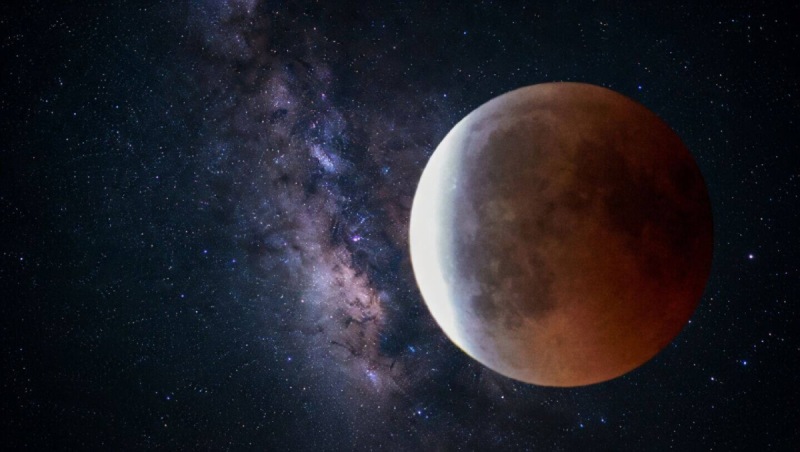
On Aug. 27-28, 2026, a remarkably deep partial lunar eclipse will be visible across Europe, Africa, North America, and South America, with slightly more than 96% of the moon passing through Earth’s shadow.
Lunar eclipses occur when Earth moves directly between the sun and a full moon. During this alignment, the moon travels through Earth’s umbra, the darkest central portion of the planet’s shadow.
Where Will the August 2026 Partial Lunar Eclipse Be Visible?
The most favorable viewing opportunities for the August 2026 partial lunar eclipse will be in North and South America. According to Time and Date, approximately 12% of the global population — around 987 million people — will be able to observe every stage of the eclipse, including both the penumbral and partial phases. Meanwhile, about 16% of the world’s population, or roughly 1.3 billion people, will witness the entire partial phase.
Weather conditions will play a major role in visibility, with western regions of the United States, northern Chile, and inland areas of Brazil statistically offering some of the best chances for clear skies.
What Will Happen During the Partial Lunar Eclipse?
The Aug. 27-28, 2026, eclipse will be the first deep partial lunar eclipse visible anywhere on Earth since Sept. 18, 2024, and the last one until Jan. 11-12, 2028, when only 2.4% of the moon will enter Earth’s umbral shadow. As a result, the 2026 event will be the most dramatic lunar eclipse until the total lunar eclipse scheduled for Dec. 31, 2028.
During the eclipse, the full “Sturgeon Moon” will rise and later move into Earth’s umbral shadow. As the moon enters the shadow, its brightness will diminish, and near maximum eclipse it will take on a faint reddish-orange appearance. However, it will not qualify as a true “blood moon” because totality will never occur. A blood moon requires the entire lunar disk to be immersed within Earth’s shadow.
Including both the subtle penumbral phase — when the moon passes through Earth’s outer shadow — and the partial eclipse itself, the event will last 5 hours and 38 minutes.
This eclipse will occur a little more than five days after the moon reaches apogee, the point in its slightly elliptical orbit where it is farthest from Earth, causing it to appear close to its average apparent size.
What Time Will the August 2026 Partial Lunar Eclipse Occur in North America?
Lunar eclipses take place simultaneously worldwide in universal time, although local viewing times vary by location and whether the moon is above the horizon.
The eclipse will occur between 9:23 p.m. EDT on Thursday, Aug. 27, and 3:01 a.m. EDT on Friday, Aug. 28 (0123 to 0701 GMT on Aug. 28, 2026). Maximum eclipse will occur at 0412 GMT, when 96.2% of the moon’s visible surface will appear covered by Earth’s shadow and display a reddish tint.
The corresponding local times for maximum eclipse across North America are:
- Eastern Time: 12:12 a.m. EDT on Friday, Aug. 28, 2026
- Central Time: 11:12 p.m. CDT on Thursday, Aug. 27, 2026
- Mountain Time: 10:12 p.m. MDT on Thursday, Aug. 27, 2026
- Pacific Time: 9:12 p.m. PDT on Thursday, Aug. 27, 2026
- Alaska Time: 8:12 p.m. AKDT on Thursday, Aug. 27, 2026
These times represent the moment of greatest eclipse. Observers may want to begin watching about 39 minutes beforehand to see Earth’s shadow gradually advance across the lunar surface and continue observing afterward as the process reverses.
What Time Will the August 2026 Partial Lunar Eclipse Occur in Europe?
Across Europe, the eclipse will take place during the early morning hours of Friday, Aug. 28. In many locations, the moon will set while the partial eclipse is still underway.
The times for maximum eclipse in selected European cities are:
London, U.K.: 5:12 a.m. BST on Aug. 28, 2026 (sunrise at 6:06 a.m. BST; moonset at 6:15 a.m. BST)
Paris, France: 6:12 a.m. CEST on Aug. 28, 2026 (sunrise at 7:01 a.m. CEST; moonset at 7:09 a.m. CEST)
Madrid, Spain: 6:12 a.m. CEST on Aug. 28, 2026 (sunrise at 7:38 a.m. CEST; moonset at 7:46 a.m. CEST)
Brussels, Belgium: 6:12 a.m. CEST on Aug. 28, 2026 (sunrise at 6:49 a.m. CEST; moonset at 6:58 a.m. CEST)
Berlin, Germany: 6:12 a.m. CEST on Aug. 28, 2026 (sunrise at 6:10 a.m. CEST; moonset at 6:17 a.m. CEST)
Locations farther east than these cities will not be able to view the moment of maximum eclipse.
When Is the Next Total Lunar Eclipse?
The following total lunar eclipses are scheduled after the August 2026 event:
Dec. 31, 2028-Jan. 1, 2029: Visible from Europe, Asia, Australia, Africa, Northern and Western North America, the Pacific Ocean, the Atlantic Ocean, the Indian Ocean, and the Arctic.
June 25-26, 2029: Visible from Europe, Western Asia, Africa, North America, South America, the Pacific Ocean, the Atlantic Ocean, the Indian Ocean, and Antarctica.
Dec. 20-21, 2029: Visible from Europe, Asia, Northern and Western Australia, Africa, North America, South America, the Pacific Ocean, the Atlantic Ocean, the Indian Ocean, and the Arctic.








Choosing a Roof That Lasts: A Homeowner’s Material Checklist

Spotify Extends Audiobook Availability to More Than 180 Markets Worldwide

How Fahad Riaz Is Taking a Four Decade Family Legacy Forward With Milele Prime

Alicia Lacao-Green gains worldwide fame owing to her amazing transformations via make-up and contouring.

Amplifyou, an amazing agency for eCommerce

Vasid Qureshi, India’s Top Blogger Shares 5 Tips to Go Viral on Social Media

Choosing a Roof That Lasts: A Homeowner’s Material Checklist
A roof rarely fails all at once. It starts with a few lifted shingles after a windy week, a damp patch on...

Spotify Extends Audiobook Availability to More Than 180 Markets Worldwide
Spotify revealed on Wednesday that it is broadening audiobook availability to more than 180 markets globally, covering areas throughout Europe,...

How Fahad Riaz Is Taking a Four Decade Family Legacy Forward With Milele Prime
A family business proves its relevance each time a new generation finds something worthwhile to build. For Fahad Riaz, Milele...


Outgrowing Isn’t Giving Up: Hayson Tasher Sr. on Choosing Growth
Sometimes, the biggest opportunities begin when you realize you have outgrown where you are. For Hayson Tasher Sr., that realization...


Apple Pay Launches in India With Axis Bank as First Banking Partner
Apple started introducing Apple Pay in India on Tuesday. Axis Bank, the country’s third-largest private-sector lender, is its first banking...
-

 Sports3 weeks ago
MLB 2026 Playoffs: Full Postseason Schedule, Wild Card and World Series Dates, Games, and TV Networks
-

 Science4 weeks ago
September 2026 Full Moon: When, Where, and How to See the Harvest Moon
-

 Tech3 weeks ago
Google Will Replace Gemini Gems With Skills in November 2026
-

 Tech4 weeks ago
Google Gemini for macOS Adds Support for Apple Messages
-

 Tech4 weeks ago
Startup Compliance Checklist: Product Registrations Before You Scale in 2026
-

 Gadget3 weeks ago
How to Customize AirPods Settings in iOS 27
-

 Business3 weeks ago
Gastauer Family Office Gives Nature Finance A Longer Time Horizon
-

 Health3 weeks ago
The Beauty of Being Yourself: Brigitta Würfl’s Approach to Timeless Aesthetics