
World
Japan to Host NATO’s First Office in Asia-Pacific to Deepen Regional Partnerships

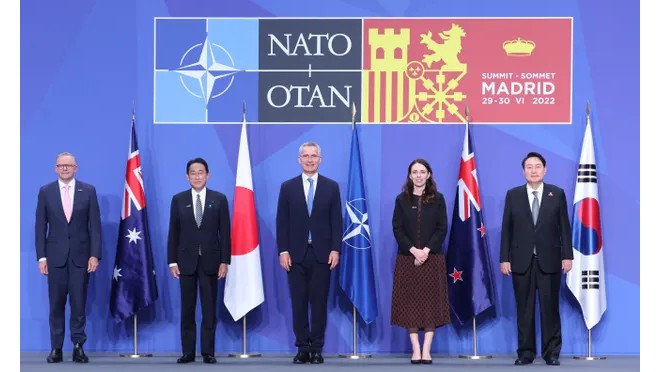
Nato intends to establish a liaison office in Japan in order to coordinate with close partners in the Indo-Pacific region, such as South Korea, Australia, and New Zealand.
The Chinese government, which has previously cautioned the Western alliance against spreading “its tentacles to the Asia-Pacific,” is likely to voice its disapproval of the plans.
Nato and Japan intend to update their collaboration on handling cyber threats, disinformation, and arising and disruptive technologies.
Nato’s new liaison office in Tokyo, which is scheduled to open next year, will be the first of its kind in Asia. It will enable the military alliance to conduct periodic consultations with Japan and key partners like Australia.
According to the publication, Japanese and NATO officials confirmed the plans.
Even though Russia remained “the most significant and direct threat to allies’ security,” Nato argued in its “strategic concept” that China posed “systemic challenges” to Euro-Atlantic security.
Nato promised to “strengthen dialogue and cooperation with new and existing partners in the Indo-Pacific to tackle cross-regional challenges and shared security interests”.
China was accused of “malicious hybrid and cyber operations” and “remaining opaque about its strategy, intentions and military build-up,” according to Nato.
China asked NATO to “stop provoking confrontation by drawing ideological lines” in response to the NATO assessment.
Zhao Lijian, a spokesperson for the Chinese foreign ministry, stated the last year that Nato had “extended its tentacles to the Asia-Pacific and sought to export the cold war mentality and replicate bloc confrontation,” and that this was the case.
Anthony Albanese, the prime minister of Australia, went to the Nato summit in Madrid last year. On the sidelines, Australia, Japan, South Korea, and New Zealand, the leaders of the Asia Pacific Partners (AP4) group, met.
Albanese has accepted an invitation to attend the upcoming NATO summit in Lithuania in July in Vilnius.
A spokesperson for Albanese stated last month, “Australia shares with Nato members a commitment to supporting democracy, peace, and security and upholding the rule of law.”
Concerns about China’s impact on trans-European security, according to Peter Taksoe-Jensen, the Danish ambassador to Japan, necessitated “important for Nato to keep up relations with our partners in this region,” he told.
“Would be a very visible, real way to strengthen the relations between Japan and Nato,” he stated of the proposed new Nato liaison office.
Japan’s prime minister, Fumio Kishida, who will host the G7 summit in Hiroshima one month from now, has said he sees the security environment within East Asia with a “strong sense of crisis”.
In reference to worries about China’s expectations towards self-governed Taiwan, Kishida has more than once contended that “Ukraine today may be East Asia tomorrow”.
After the G7 summit – which Albanese has been invited to join – Kishida will travel to Sydney for the Quad leaders’ summit.
For the talks on May 24 at the Sydney Opera House, Albanese will host Kishida, US President Joe Biden, and Indian Prime Minister Narendra Modi.



Black Banx H1 2026 Results Reveal the Power of Operating Leverage

Gemini Expands Connected Apps With Ticketmaster, Angi, Zocdoc and More

2026 Total Solar Eclipse: Where to Watch and How to View It Safely

Alicia Lacao-Green gains worldwide fame owing to her amazing transformations via make-up and contouring.

Amplifyou, an amazing agency for eCommerce

Vasid Qureshi, India’s Top Blogger Shares 5 Tips to Go Viral on Social Media

Black Banx H1 2026 Results Reveal the Power of Operating Leverage
Black Banx combined 115.3 million customers and USD 153.3 billion in deposits with stronger quarterly efficiency, showing how a global...

Gemini Expands Connected Apps With Ticketmaster, Angi, Zocdoc and More
AI assistants become considerably more useful when they can interact with other parts of your digital life, and Gemini is...

2026 Total Solar Eclipse: Where to Watch and How to View It Safely
The total solar eclipse on Aug. 12, 2026 will travel across sections of the Northern Hemisphere, giving millions of people...


Ella Langley and Morgan Wallen Score Country Airplay No. 1 With “I Can’t Love You Anymore”
Ella Langley and Morgan Wallen claim their fifth and 22nd Country Airplay No. 1s, respectively, as “I Can’t Love You...


Aspiring Galaxy Traveler: Raphael Chudaitov on Evolution, Responsibility, and the Future of Humanity
Reaching the stars sounds glamorous. Surviving each other on Earth is the harder mission. Raphael Chudaitov calls himself an aspiring...
-

 Entertainment4 weeks ago
Post Malone Debuts New Song During FIFA World Cup 2026 Final Closing Ceremony
-

 Entertainment2 weeks ago
Universal Becomes First Studio to Pass $4 Billion at 2026 Global Box Office
-

 Entertainment4 weeks ago
Future Earns 12th Billboard 200 No. 1 Album With The Real Me
-

 Entertainment4 weeks ago
Shakira and Burna Boy’s “Dai Dai” Continues Global Chart Reign After FIFA World Cup 2026
-

 Science4 weeks ago
How to Watch the Perseid Meteor Shower 2026 and Other July Meteor Displays
-
Business2 days ago
Black Banx H1 2026 Results Reveal the Power of Operating Leverage
-

 Business1 week ago
What to Know before Using Insurance for Scratches, Dents and Small Repairs
-

 Tech3 weeks ago
The Psychographic Playbook: Aligning Your Messaging with Your Audience’s Core Values