
Tech
Users of iPhones can move the Omnibox to the bottom in Google Chrome like Safari’s bottom nav bar

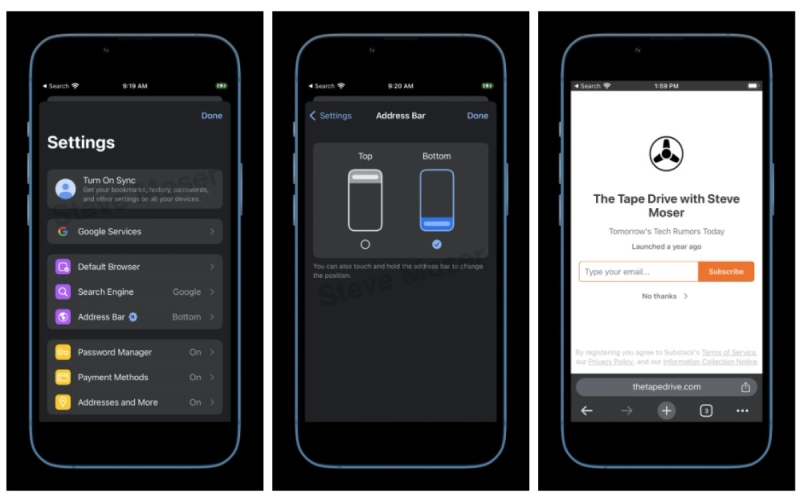
Android users using Google Chrome in the year 2020 wept in grief as the long-running Chrome Duet experiment came to an end. The address bar, also known as the Omnibox, may be moved from the top of the screen to the bottom by turning on the Duet feature flag. Before killing Duet, Google worked on it for four years, and Chrome users on Android still can’t move the Omnibox to the bottom. However, consumers now have a method to do precisely that thanks to Chrome on iPhone.
The address bar has always been located at the bottom of the screen in Safari, Apple’s default web browser. The Omnibox on Chrome for iPhone has always been at the top, which can be inconvenient for productivity. According to Steve Moser of The Tape Drive, iPhone Chrome users can now utilize a feature flag to move the Omnibox from the top to the bottom.
According to MacRumors contributor Steve Moser, a test version of Google Chrome for iOS now allows you to position the address bar at the bottom of the screen. It’s a good improvement that enables you to bring the address bar closer to your thumb; nevertheless, it should be noted that it comes two years after Apple made the URL bar the default location for Safari in iOS 15.
Two years after Apple’s Safari made the same change, Google is testing a feature in its Chrome browser for iOS that allows users to move the address bar to the bottom of the screen.
The URL bar and tab interface were relocated to the bottom of the iPhone by Apple in the iOS 15 beta testing period, a change that at first caused controversy among iPhone owners.
It was made simpler to navigate with one hand by placing the bar at the bottom of the interface, but not everyone was pleased. Apple included a setting to display the address bar at the top of the iPhone rather than the bottom for those who wanted the more iOS 14-like experience after hearing user input.
It’s unclear if Chrome will implement the adjustment for all users. Google attempted to implement a similar modification in Chrome for Android in 2017, but the feature was later taken away. But given that iPhone screens have generally become bigger over time, many people will probably embrace the shift if it takes hold.











2026 Total Solar Eclipse: Where to Watch and How to View It Safely

Ella Langley and Morgan Wallen Score Country Airplay No. 1 With “I Can’t Love You Anymore”

Aspiring Galaxy Traveler: Raphael Chudaitov on Evolution, Responsibility, and the Future of Humanity

Alicia Lacao-Green gains worldwide fame owing to her amazing transformations via make-up and contouring.

Amplifyou, an amazing agency for eCommerce

Vasid Qureshi, India’s Top Blogger Shares 5 Tips to Go Viral on Social Media
2026 Total Solar Eclipse: Where to Watch and How to View It Safely
The total solar eclipse on Aug. 12, 2026 will travel across sections of the Northern Hemisphere, giving millions of people...

Ella Langley and Morgan Wallen Score Country Airplay No. 1 With “I Can’t Love You Anymore”
Ella Langley and Morgan Wallen claim their fifth and 22nd Country Airplay No. 1s, respectively, as “I Can’t Love You...

Aspiring Galaxy Traveler: Raphael Chudaitov on Evolution, Responsibility, and the Future of Humanity
Reaching the stars sounds glamorous. Surviving each other on Earth is the harder mission. Raphael Chudaitov calls himself an aspiring...


What to Know before Using Insurance for Scratches, Dents and Small Repairs
Scratches, dents and small repairs can look minor, yet the decision to claim deserves careful thought. Insurance may help when...


Covering Unexpected Expenses When Payday Feels Too Far Away
Life has a way of sending you a bill at the worst possible moment. Your car breaks down on a...
-

 Entertainment3 weeks ago
Post Malone Debuts New Song During FIFA World Cup 2026 Final Closing Ceremony
-

 Entertainment1 week ago
Universal Becomes First Studio to Pass $4 Billion at 2026 Global Box Office
-

 Entertainment3 weeks ago
Shakira and Burna Boy’s “Dai Dai” Continues Global Chart Reign After FIFA World Cup 2026
-

 Entertainment3 weeks ago
Future Earns 12th Billboard 200 No. 1 Album With The Real Me
-

 Science3 weeks ago
How to Watch the Perseid Meteor Shower 2026 and Other July Meteor Displays
-

 Entertainment4 weeks ago
Daytime Emmy Awards 2026: Talk Show Nominees Announced
-

 Entertainment4 weeks ago
Madonna and Michael Jackson Reunite in Billboard 200 Top 10 After Nearly 25 Years
-

 Tech3 weeks ago
The Psychographic Playbook: Aligning Your Messaging with Your Audience’s Core Values