
Tech
From Soil to Silicon: The Rise of Agriculture AI and Drone Innovations in 2025

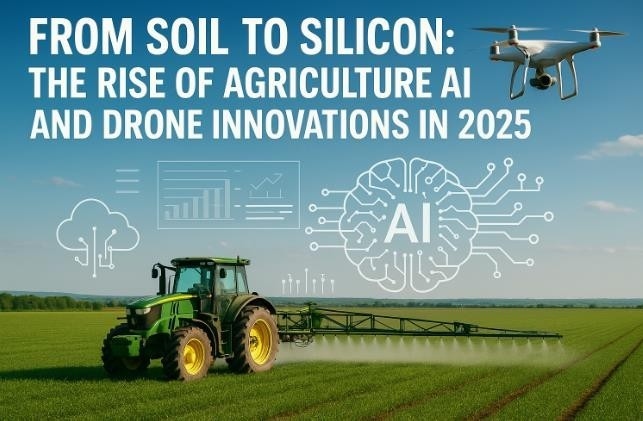
In 2025, agriculture is entering a new era—one where the age-old connection between farmers and soil converges with cutting-edge AI and drone technologies. This transformation, dubbed “from soil to silicon,” is reshaping how crops are grown, protected, and managed, delivering higher yields, lowered costs, and a more sustainable future for farming.
1. Precision Farming: Data-Driven Cultivation
Gone are the days when farmers relied solely on soil tests or satellite images. Today’s AI-powered drones and machines map soil properties—like moisture, nutrient density, and pH—at centimeter-level resolution. These insights allow variable-rate irrigation and fertilization, optimizing inputs based on real-time data—cutting water and chemical use, while improving yields by roughly 20%. Institutions like Syngenta Group and the World Economic Forum (WEF) have emphasized this
shift. Syngenta CEO Jeff Rowe highlighted five core AI trends defining agri-tech in 2025— especially AI-driven soil analysis and advisory tools that operate within farmers’ hands.
2. Drones: The Eyes & Tools of the Field
Drones are at the forefront of the soil-to-silicon leap:
- Survey & Monitoring: Multispectral and thermal cameras onboard drones detect early signs of pest infestations, nutrient deficiencies, or water stress—often before human observation is possible. This enables on-demand treatment and improves resource management.
- AI-Powered Spraying: High-capacity models like DJI Agras T50—armed with onboard AI and radar—discern weeds from crops and spray only when necessary. Early adopters in Brazil saw costs drop 70% compared to manual spraying, while Romania’s vineyards halved chemical usage on steep slopes.
- Farmers’ ROI Gains: Commercial reports suggest that precision spraying can increase productivity by 20% and reduce overall input costs—yielding both economic benefits for farmers and environmental gains via reduced runoff.
- Livestock Management: In Australia, platforms like SkyKelpie deploy drones for livestock mustering—herding cattle, reducing the need for helicopters or motorbikes. With AI enhancements, some operations achieve over 250% ROI, showcasing drones’ versatility beyond crop fields.
In 2025, agriculture stands at the frontier of transformation. From soil to silicon, AI and drone technologies are ushering in smarter, more sustainable farming. As these tools weave together— mapping soil health, monitoring crops mid-season, spraying with surgical precision, and even herding livestock—the farm of tomorrow is taking shape.
To realize the full promise of this revolution, stakeholders—from farmers and startups to policymakers—must continue working together. That means improving access, harmonizing regulations, supporting training platforms, and safeguarding data. With strategic action, the rise of
Agriculture AI and drone innovations won’t just be a technological marvel—it will become a cornerstone of food security, rural development, and planetary stewardship.
Dr. Vijay Bhardwaj
Professor
Chandigarh University











Choosing a Roof That Lasts: A Homeowner’s Material Checklist

Spotify Extends Audiobook Availability to More Than 180 Markets Worldwide

How Fahad Riaz Is Taking a Four Decade Family Legacy Forward With Milele Prime

Alicia Lacao-Green gains worldwide fame owing to her amazing transformations via make-up and contouring.

Amplifyou, an amazing agency for eCommerce

Vasid Qureshi, India’s Top Blogger Shares 5 Tips to Go Viral on Social Media

Choosing a Roof That Lasts: A Homeowner’s Material Checklist
A roof rarely fails all at once. It starts with a few lifted shingles after a windy week, a damp patch on...

Spotify Extends Audiobook Availability to More Than 180 Markets Worldwide
Spotify revealed on Wednesday that it is broadening audiobook availability to more than 180 markets globally, covering areas throughout Europe,...

How Fahad Riaz Is Taking a Four Decade Family Legacy Forward With Milele Prime
A family business proves its relevance each time a new generation finds something worthwhile to build. For Fahad Riaz, Milele...


Outgrowing Isn’t Giving Up: Hayson Tasher Sr. on Choosing Growth
Sometimes, the biggest opportunities begin when you realize you have outgrown where you are. For Hayson Tasher Sr., that realization...


Apple Pay Launches in India With Axis Bank as First Banking Partner
Apple started introducing Apple Pay in India on Tuesday. Axis Bank, the country’s third-largest private-sector lender, is its first banking...
-

 Sports3 weeks ago
MLB 2026 Playoffs: Full Postseason Schedule, Wild Card and World Series Dates, Games, and TV Networks
-

 Science4 weeks ago
September 2026 Full Moon: When, Where, and How to See the Harvest Moon
-

 Tech3 weeks ago
Google Will Replace Gemini Gems With Skills in November 2026
-

 Tech4 weeks ago
Google Gemini for macOS Adds Support for Apple Messages
-

 Tech4 weeks ago
Startup Compliance Checklist: Product Registrations Before You Scale in 2026
-

 Gadget3 weeks ago
How to Customize AirPods Settings in iOS 27
-

 Business4 weeks ago
Gastauer Family Office Gives Nature Finance A Longer Time Horizon
-

 Health3 weeks ago
The Beauty of Being Yourself: Brigitta Würfl’s Approach to Timeless Aesthetics